Aug 30, 2026pneumatic cylinder
Compact vs Standard Pneumatic Cylinders: Which Should You Choose?
The best cylinder is the one that fits the complete operating condition—not merely the available space.
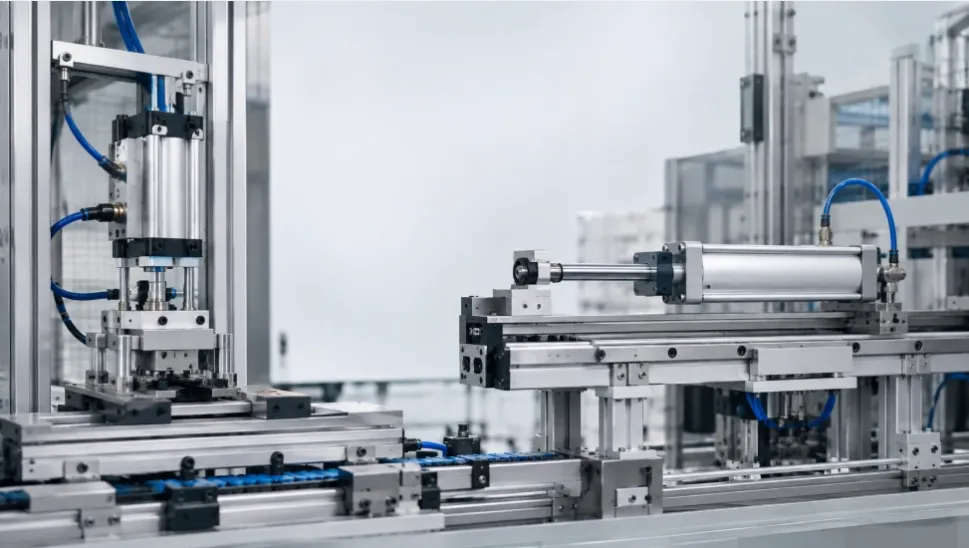
Compact vs Standard Pneumatic Cylinders: Which Should You Choose?
Choosing between a compact pneumatic cylinder and a standard pneumatic cylinder is not simply matter of selecting the smaller or less expensive option. Both types convert compressed air into linear motion, but their construction and operating characteristics suit different machine designs.
A good selection begins with the application: how much space is available, how far the load must move, how much force is required, and how the load will be supported.
What Is a Compact Pneumatic Cylinder?
A compact cylinder is designed to provide useful force within a short body length. Its piston and end covers are arranged to minimize the space required in the direction of movement.
Compact cylinders are commonly used in packaging machines, assembly fixtures, electronic equipment, inspection systems and other machines with limited installation space. Typical operations include short-distance clamping, lifting, stopping, pressing and product ejection.
Many compact models can be mounted directly through holes in the cylinder body. This makes installation simple and often eliminates separate brackets. Magnetic piston options are also widely available for applications that require position feedback.
The main limitation is usually stroke. Compact cylinders are best suited to short or moderate travel. They may also offer fewer mounting and cushioning options than a larger standard cylinder.
What Is a Standard Pneumatic Cylinder?
A standard pneumatic cylinder normally has a longer body and a more conventional piston-rod arrangement. Common examples include profile cylinders, tie-rod cylinders and round-body cylinders.
Standard cylinders are available in a broad range of bore sizes and strokes. They are often selected for pushing, pulling, lifting, feeding and opening mechanisms in general industrial equipment.
Their longer construction provides more room for internal components such as adjustable pneumatic cushions. These cushions slow the piston near the end of the stroke, reducing impact when the cylinder moves at higher speed or carries a heavier load.
Standard cylinders also tend to offer more mounting accessories, including foot brackets, front and rear flanges, clevises and trunnions. This flexibility is useful when the cylinder must be adapted to an existing machine structure.
Installation Space
Space is the clearest difference between the two designs.
When a machine has very little room behind the moving mechanism, a compact cylinder is often the better choice. It can provide the required stroke without making the equipment unnecessarily deep.
A standard cylinder requires more axial space, but this is not always a disadvantage. The longer body may make air ports, speed controllers and magnetic switches easier to access. Maintenance can also be simpler when the installation is not tightly packed.
Before selecting either type, check the complete retracted length, extended length, fitting clearance and space needed for tools.
Stroke and Load Requirements
Compact cylinders work well for short strokes, but a standard cylinder is usually more practical for longer travel.
The cylinder bore determines its theoretical force, while the stroke determines how far the load moves. Two cylinders with the same bore can produce similar theoretical force at the same pressure, even if one is compact and the other is standard.
However, neither cylinder should be expected to guide an unsupported load. Side force, poor alignment or an offset load can damage the piston rod and seals. If the load can rotate or create a bending moment, use an external linear guide or select a guided-cylinder model.
Speed and Cushioning
For lightweight, short-stroke movement, a compact cylinder with rubber bumpers may be sufficient. When the load is heavier or the operating speed is higher, adjustable pneumatic cushioning is often preferable.
Standard cylinders commonly offer more effective end cushioning. This can reduce noise, vibration and wear, particularly in packaging, material-handling and assembly machines that operate continuously.
An external shock absorber may still be necessary when the moving load has high kinetic energy.
Cost and Maintenance
A compact cylinder can reduce machine size and mounting-component costs. However, the cylinder price should not be considered alone. Difficult access, an unsuitable stroke or inadequate load guidance can increase maintenance costs later.
Standard cylinders may require more space, but their mounting flexibility, replaceable accessories and wider selection of strokes can make them more economical over the life of the equipment.
Which Cylinder Should You Choose?
Choose a compact pneumatic cylinder when:
- Installation space is limited.
- The required stroke is relatively short.
- The moving load is light and properly guided.
- Direct body mounting simplifies the machine design.
- A low-profile actuator is required.
Choose a standard pneumatic cylinder when:
- A longer stroke is required.
- The application needs adjustable cushioning.
- Several mounting arrangements must be considered.
- The cylinder operates at higher speed or handles a heavier load.
- Easier access and maintenance are important.
The best cylinder is the one that fits the complete operating condition—not merely the available space. Before ordering, confirm the bore, stroke, pressure, load, speed, mounting method, cushioning and position-sensing requirements. A careful selection at the design stage helps prevent leakage, premature wear and unstable machine performance.