
Sep 16, 2026pneumatic cylinder

DNC vs SC Pneumatic Cylinder: Which One Should You Choose?

This article compares DNC and SC pneumatic cylinders, highlighting their design, applications, and key differences.
84f5909c-1219-48f0-9ad6-41c69a640f28
DNC vs SC Pneumatic Cylinder: Which One Should You Choose?
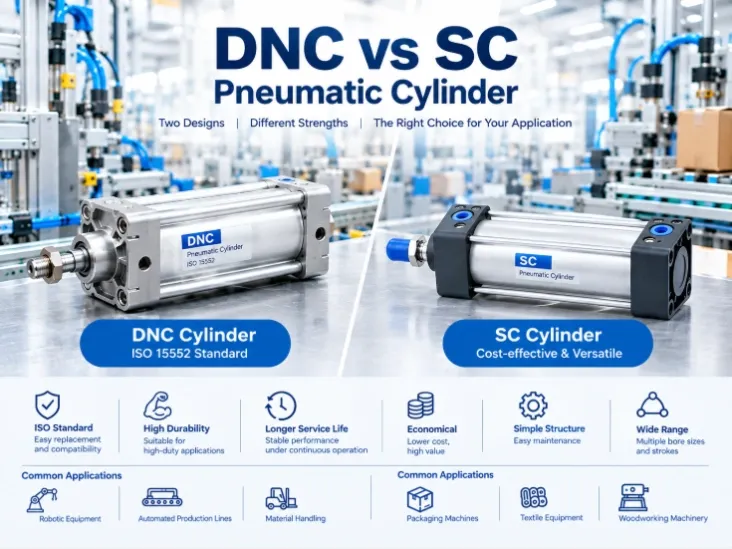
When selecting a pneumatic cylinder for an automation project, two of the most common choices are the DNC cylinder and the SC cylinder. Although both are designed to convert compressed air into linear motion, they are built for different applications. Understanding their differences can help engineers and purchasing managers choose the right product for better performance, longer service life, and lower maintenance costs.

What is an SC Pneumatic Cylinder?

The SC cylinder is one of the most widely used standard pneumatic cylinders in industrial automation. It features a simple structure, competitive price, and easy maintenance, making it a popular option for general-purpose machinery.
SC cylinders are commonly found in packaging machines, textile equipment, woodworking machinery, printing machines, and light industrial automation. They are available in a wide range of bore sizes and strokes, allowing them to meet the needs of many standard applications.
For projects where cost efficiency is a priority and working conditions are relatively moderate, the SC cylinder is often the preferred choice.

What is a DNC Pneumatic Cylinder?

The DNC cylinder is designed according to the ISO 15552 standard, making it compatible with many internationally recognized mounting accessories and replacement parts. Compared with an SC cylinder, a DNC cylinder usually offers a more robust structure and improved durability.
Because of its standardized dimensions and higher mechanical strength, the DNC cylinder is widely used in automated production lines, robotic equipment, material handling systems, and other applications requiring continuous operation.
For users who need stable performance over long production cycles, the DNC cylinder is an excellent investment.

Key Differences Between DNC and SC Cylinders

The most noticeable difference is design standardization. DNC cylinders follow the ISO 15552 standard, making installation and replacement much easier in international equipment. SC cylinders, while highly versatile, are generally based on more traditional designs and may not always share the same mounting dimensions.
Another difference is application. SC cylinders are ideal for standard industrial equipment where cost control is important. DNC cylinders are better suited for high-duty applications that require greater precision, stronger construction, and longer operating life.
Maintenance is another consideration. Because DNC cylinders are designed for long-term industrial use, they often provide smoother operation and longer maintenance intervals.

Which Cylinder is right for you?

If your machine operates under normal working conditions and budget is a key concern, an SC cylinder can provide excellent value. It offers reliable performance while keeping equipment costs under control.
However, if your equipment runs continuously, requires international standard compatibility, or operates in demanding production environments, a DNC cylinder is usually the better choice. Its stronger construction and standardized design help reduce downtime and simplify future maintenance.

Choosing a reliable supplier

High-quality cylinders use precision-machined components, durable seals, and strict quality control to ensure consistent performance.
Our cylinder, the front and rear end covers of our DNC cylinders are produced through our own die-casting process, allowing us to maintain tighter dimensional control. We also use wear-resistant sealing materials and premium German-imported lubricants, which help reduce friction and extend service life under continuous operation.
Whether you choose an SC cylinder or DNC cylinder, selecting a dependable supplier ensures better reliability, fewer maintenance issues, and a lower total cost of ownership over the life of your equipment.
Read next

Sep 16, 2026pneumatic cylinder

DNC vs SC Pneumatic Cylinder: Which One Should You Choose?

This article compares DNC and SC pneumatic cylinders, highlighting their design, applications, and key differences.

84f5909c-1219-48f0-9ad6-41c69a640f28
DNC vs SC Pneumatic Cylinder: Which One Should You Choose?
When selecting a pneumatic cylinder for an automation project, two of the most common choices are the DNC cylinder and the SC cylinder. Although both are designed to convert compressed air into linear motion, they are built for different applications. Understanding their differences can help engineers and purchasing managers choose the right product for better performance, longer service life, and lower maintenance costs.

What is an SC Pneumatic Cylinder?

The SC cylinder is one of the most widely used standard pneumatic cylinders in industrial automation. It features a simple structure, competitive price, and easy maintenance, making it a popular option for general-purpose machinery.
SC cylinders are commonly found in packaging machines, textile equipment, woodworking machinery, printing machines, and light industrial automation. They are available in a wide range of bore sizes and strokes, allowing them to meet the needs of many standard applications.
For projects where cost efficiency is a priority and working conditions are relatively moderate, the SC cylinder is often the preferred choice.

What is a DNC Pneumatic Cylinder?

The DNC cylinder is designed according to the ISO 15552 standard, making it compatible with many internationally recognized mounting accessories and replacement parts. Compared with an SC cylinder, a DNC cylinder usually offers a more robust structure and improved durability.
Because of its standardized dimensions and higher mechanical strength, the DNC cylinder is widely used in automated production lines, robotic equipment, material handling systems, and other applications requiring continuous operation.
For users who need stable performance over long production cycles, the DNC cylinder is an excellent investment.

Key Differences Between DNC and SC Cylinders

The most noticeable difference is design standardization. DNC cylinders follow the ISO 15552 standard, making installation and replacement much easier in international equipment. SC cylinders, while highly versatile, are generally based on more traditional designs and may not always share the same mounting dimensions.
Another difference is application. SC cylinders are ideal for standard industrial equipment where cost control is important. DNC cylinders are better suited for high-duty applications that require greater precision, stronger construction, and longer operating life.
Maintenance is another consideration. Because DNC cylinders are designed for long-term industrial use, they often provide smoother operation and longer maintenance intervals.

Which Cylinder is right for you?

If your machine operates under normal working conditions and budget is a key concern, an SC cylinder can provide excellent value. It offers reliable performance while keeping equipment costs under control.
However, if your equipment runs continuously, requires international standard compatibility, or operates in demanding production environments, a DNC cylinder is usually the better choice. Its stronger construction and standardized design help reduce downtime and simplify future maintenance.

Choosing a reliable supplier

High-quality cylinders use precision-machined components, durable seals, and strict quality control to ensure consistent performance.
Our cylinder, the front and rear end covers of our DNC cylinders are produced through our own die-casting process, allowing us to maintain tighter dimensional control. We also use wear-resistant sealing materials and premium German-imported lubricants, which help reduce friction and extend service life under continuous operation.
Whether you choose an SC cylinder or DNC cylinder, selecting a dependable supplier ensures better reliability, fewer maintenance issues, and a lower total cost of ownership over the life of your equipment.

Sep 16, 2026pneumatic cylinder

DNC vs SC Pneumatic Cylinder: Which One Should You Choose?

This article compares DNC and SC pneumatic cylinders, highlighting their design, applications, and key differences.

84f5909c-1219-48f0-9ad6-41c69a640f28
DNC vs SC Pneumatic Cylinder: Which One Should You Choose?
When selecting a pneumatic cylinder for an automation project, two of the most common choices are the DNC cylinder and the SC cylinder. Although both are designed to convert compressed air into linear motion, they are built for different applications. Understanding their differences can help engineers and purchasing managers choose the right product for better performance, longer service life, and lower maintenance costs.

What is an SC Pneumatic Cylinder?

The SC cylinder is one of the most widely used standard pneumatic cylinders in industrial automation. It features a simple structure, competitive price, and easy maintenance, making it a popular option for general-purpose machinery.
SC cylinders are commonly found in packaging machines, textile equipment, woodworking machinery, printing machines, and light industrial automation. They are available in a wide range of bore sizes and strokes, allowing them to meet the needs of many standard applications.
For projects where cost efficiency is a priority and working conditions are relatively moderate, the SC cylinder is often the preferred choice.

What is a DNC Pneumatic Cylinder?

The DNC cylinder is designed according to the ISO 15552 standard, making it compatible with many internationally recognized mounting accessories and replacement parts. Compared with an SC cylinder, a DNC cylinder usually offers a more robust structure and improved durability.
Because of its standardized dimensions and higher mechanical strength, the DNC cylinder is widely used in automated production lines, robotic equipment, material handling systems, and other applications requiring continuous operation.
For users who need stable performance over long production cycles, the DNC cylinder is an excellent investment.

Key Differences Between DNC and SC Cylinders

The most noticeable difference is design standardization. DNC cylinders follow the ISO 15552 standard, making installation and replacement much easier in international equipment. SC cylinders, while highly versatile, are generally based on more traditional designs and may not always share the same mounting dimensions.
Another difference is application. SC cylinders are ideal for standard industrial equipment where cost control is important. DNC cylinders are better suited for high-duty applications that require greater precision, stronger construction, and longer operating life.
Maintenance is another consideration. Because DNC cylinders are designed for long-term industrial use, they often provide smoother operation and longer maintenance intervals.

Which Cylinder is right for you?

If your machine operates under normal working conditions and budget is a key concern, an SC cylinder can provide excellent value. It offers reliable performance while keeping equipment costs under control.
However, if your equipment runs continuously, requires international standard compatibility, or operates in demanding production environments, a DNC cylinder is usually the better choice. Its stronger construction and standardized design help reduce downtime and simplify future maintenance.

Choosing a reliable supplier

High-quality cylinders use precision-machined components, durable seals, and strict quality control to ensure consistent performance.
Our cylinder, the front and rear end covers of our DNC cylinders are produced through our own die-casting process, allowing us to maintain tighter dimensional control. We also use wear-resistant sealing materials and premium German-imported lubricants, which help reduce friction and extend service life under continuous operation.
Whether you choose an SC cylinder or DNC cylinder, selecting a dependable supplier ensures better reliability, fewer maintenance issues, and a lower total cost of ownership over the life of your equipment.


Recommended articles

Guides visitors may want next

Helpful guides, field notes, and stories for choosing with more context.