
Sep 10, 2026pneumatic cylinder

Pneumatic Cylinder Bore Size and Stroke Selection Guide

Choosing the correct pneumatic cylinder bore size and stroke improves machine performance, reliability, and efficiency.
488e96f1-f081-40a4-a61c-553da8124b28
Pneumatic Cylinder Bore Size and Stroke Selection Guide
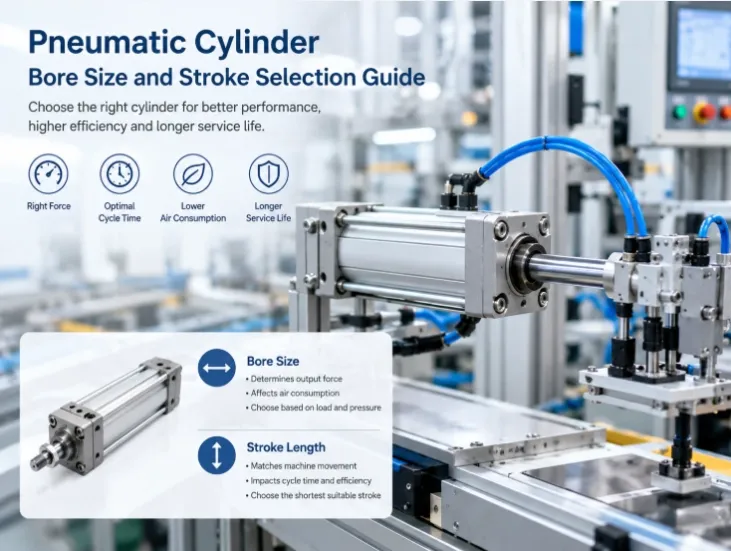
Selecting the correct pneumatic cylinder is one of the most important decisions when designing an automated machine. While many engineers focus on the cylinder series or mounting style, two specifications have the greatest impact on performance: bore size and stroke length. Choosing the right combination ensures reliable operation, improves efficiency, and helps avoid unnecessary maintenance or energy consumption.

Understanding Bore Size

The bore size refers to the internal diameter of the cylinder barrel. It directly determines the amount of force the cylinder can generate. A larger bore produces greater output force because more compressed air acts on a larger piston surface.
However, selecting the largest possible bore is not always the best solution. An oversized cylinder consumes more compressed air, increases operating costs, and may require larger valves and air tubing. On the other hand, a cylinder that is too small may struggle to move the load, especially if pressure fluctuates during production.
When selecting a bore size, engineers should consider several factors:
  • Weight of the load
  • Required pushing or pulling force
  • Operating air pressure
  • Friction within the machine
  • Safety factor for continuous operation
As a general practice, the cylinder should provide enough force to handle the maximum working load while maintaining a reasonable safety margin.

Choosing the Correct Stroke Length

Stroke is the distance the piston rod travels from its fully retracted position to its fully extended position. The correct stroke depends entirely on the machine's mechanical design and required movement.
A stroke that is too short will prevent the mechanism from completing its motion. Conversely, selecting a stroke much longer than necessary increases cycle time and may reduce production efficiency.
Whenever possible, choose the shortest stroke that fully meets the application requirements. Shorter strokes usually provide better rigidity, faster cycle times, and lower air consumption.
For applications with long travel distances, external guide systems may be required to improve stability and reduce side loading on the piston rod.

Consider the Working Environment

The operating environment also affects cylinder selection. Dust, moisture, chemicals, and high temperatures can shorten seal life if the wrong cylinder is used.
For harsh industrial environments, stainless steel piston rods, corrosion-resistant materials, or protective rod boots may be suitable options. Proper air preparation with filters and regulators is equally important for extending cylinder service life.

Matching the Cylinder to the Load

The direction of the load should always be considered. Pneumatic cylinders are designed primarily for linear motion. If the load creates side forces or bending moments, guide units or external linear guides should be added to protect the piston rod and internal bearings.
Incorrect alignment is one of the most common causes of premature seal wear and rod damage.

Don't Forget Speed Control

Cylinder speed is determined not only by air pressure but also by airflow. Flow control valves allow smooth adjustment of extension and retraction speeds, helping reduce impact at the end of each stroke.
For high-speed automation equipment, cylinders with adjustable cushioning can further reduce shock loads and improve service life.

Conclusion

Selecting the right pneumatic cylinder is more than choosing a standard model from a catalog. Bore size determines the available output force, while stroke length influences machine movement, cycle time, and overall efficiency. By carefully evaluating the load, operating pressure, travel distance, installation conditions, and working environment, engineers can select a cylinder that delivers reliable performance over the long term.
A properly sized pneumatic cylinder not only improves machine reliability but also reduces compressed air consumption, minimizes maintenance costs, and increases production efficiency. Taking the time to make the correct selection at the design stage is an investment that pays off throughout the life of the equipment.
Read next

Sep 10, 2026pneumatic cylinder

Pneumatic Cylinder Bore Size and Stroke Selection Guide

Choosing the correct pneumatic cylinder bore size and stroke improves machine performance, reliability, and efficiency.

488e96f1-f081-40a4-a61c-553da8124b28
Pneumatic Cylinder Bore Size and Stroke Selection Guide
Selecting the correct pneumatic cylinder is one of the most important decisions when designing an automated machine. While many engineers focus on the cylinder series or mounting style, two specifications have the greatest impact on performance: bore size and stroke length. Choosing the right combination ensures reliable operation, improves efficiency, and helps avoid unnecessary maintenance or energy consumption.

Understanding Bore Size

The bore size refers to the internal diameter of the cylinder barrel. It directly determines the amount of force the cylinder can generate. A larger bore produces greater output force because more compressed air acts on a larger piston surface.
However, selecting the largest possible bore is not always the best solution. An oversized cylinder consumes more compressed air, increases operating costs, and may require larger valves and air tubing. On the other hand, a cylinder that is too small may struggle to move the load, especially if pressure fluctuates during production.
When selecting a bore size, engineers should consider several factors:
  • Weight of the load
  • Required pushing or pulling force
  • Operating air pressure
  • Friction within the machine
  • Safety factor for continuous operation
As a general practice, the cylinder should provide enough force to handle the maximum working load while maintaining a reasonable safety margin.

Choosing the Correct Stroke Length

Stroke is the distance the piston rod travels from its fully retracted position to its fully extended position. The correct stroke depends entirely on the machine's mechanical design and required movement.
A stroke that is too short will prevent the mechanism from completing its motion. Conversely, selecting a stroke much longer than necessary increases cycle time and may reduce production efficiency.
Whenever possible, choose the shortest stroke that fully meets the application requirements. Shorter strokes usually provide better rigidity, faster cycle times, and lower air consumption.
For applications with long travel distances, external guide systems may be required to improve stability and reduce side loading on the piston rod.

Consider the Working Environment

The operating environment also affects cylinder selection. Dust, moisture, chemicals, and high temperatures can shorten seal life if the wrong cylinder is used.
For harsh industrial environments, stainless steel piston rods, corrosion-resistant materials, or protective rod boots may be suitable options. Proper air preparation with filters and regulators is equally important for extending cylinder service life.

Matching the Cylinder to the Load

The direction of the load should always be considered. Pneumatic cylinders are designed primarily for linear motion. If the load creates side forces or bending moments, guide units or external linear guides should be added to protect the piston rod and internal bearings.
Incorrect alignment is one of the most common causes of premature seal wear and rod damage.

Don't Forget Speed Control

Cylinder speed is determined not only by air pressure but also by airflow. Flow control valves allow smooth adjustment of extension and retraction speeds, helping reduce impact at the end of each stroke.
For high-speed automation equipment, cylinders with adjustable cushioning can further reduce shock loads and improve service life.

Conclusion

Selecting the right pneumatic cylinder is more than choosing a standard model from a catalog. Bore size determines the available output force, while stroke length influences machine movement, cycle time, and overall efficiency. By carefully evaluating the load, operating pressure, travel distance, installation conditions, and working environment, engineers can select a cylinder that delivers reliable performance over the long term.
A properly sized pneumatic cylinder not only improves machine reliability but also reduces compressed air consumption, minimizes maintenance costs, and increases production efficiency. Taking the time to make the correct selection at the design stage is an investment that pays off throughout the life of the equipment.

Sep 10, 2026pneumatic cylinder

Pneumatic Cylinder Bore Size and Stroke Selection Guide

Choosing the correct pneumatic cylinder bore size and stroke improves machine performance, reliability, and efficiency.

488e96f1-f081-40a4-a61c-553da8124b28
Pneumatic Cylinder Bore Size and Stroke Selection Guide
Selecting the correct pneumatic cylinder is one of the most important decisions when designing an automated machine. While many engineers focus on the cylinder series or mounting style, two specifications have the greatest impact on performance: bore size and stroke length. Choosing the right combination ensures reliable operation, improves efficiency, and helps avoid unnecessary maintenance or energy consumption.

Understanding Bore Size

The bore size refers to the internal diameter of the cylinder barrel. It directly determines the amount of force the cylinder can generate. A larger bore produces greater output force because more compressed air acts on a larger piston surface.
However, selecting the largest possible bore is not always the best solution. An oversized cylinder consumes more compressed air, increases operating costs, and may require larger valves and air tubing. On the other hand, a cylinder that is too small may struggle to move the load, especially if pressure fluctuates during production.
When selecting a bore size, engineers should consider several factors:
  • Weight of the load
  • Required pushing or pulling force
  • Operating air pressure
  • Friction within the machine
  • Safety factor for continuous operation
As a general practice, the cylinder should provide enough force to handle the maximum working load while maintaining a reasonable safety margin.

Choosing the Correct Stroke Length

Stroke is the distance the piston rod travels from its fully retracted position to its fully extended position. The correct stroke depends entirely on the machine's mechanical design and required movement.
A stroke that is too short will prevent the mechanism from completing its motion. Conversely, selecting a stroke much longer than necessary increases cycle time and may reduce production efficiency.
Whenever possible, choose the shortest stroke that fully meets the application requirements. Shorter strokes usually provide better rigidity, faster cycle times, and lower air consumption.
For applications with long travel distances, external guide systems may be required to improve stability and reduce side loading on the piston rod.

Consider the Working Environment

The operating environment also affects cylinder selection. Dust, moisture, chemicals, and high temperatures can shorten seal life if the wrong cylinder is used.
For harsh industrial environments, stainless steel piston rods, corrosion-resistant materials, or protective rod boots may be suitable options. Proper air preparation with filters and regulators is equally important for extending cylinder service life.

Matching the Cylinder to the Load

The direction of the load should always be considered. Pneumatic cylinders are designed primarily for linear motion. If the load creates side forces or bending moments, guide units or external linear guides should be added to protect the piston rod and internal bearings.
Incorrect alignment is one of the most common causes of premature seal wear and rod damage.

Don't Forget Speed Control

Cylinder speed is determined not only by air pressure but also by airflow. Flow control valves allow smooth adjustment of extension and retraction speeds, helping reduce impact at the end of each stroke.
For high-speed automation equipment, cylinders with adjustable cushioning can further reduce shock loads and improve service life.

Conclusion

Selecting the right pneumatic cylinder is more than choosing a standard model from a catalog. Bore size determines the available output force, while stroke length influences machine movement, cycle time, and overall efficiency. By carefully evaluating the load, operating pressure, travel distance, installation conditions, and working environment, engineers can select a cylinder that delivers reliable performance over the long term.
A properly sized pneumatic cylinder not only improves machine reliability but also reduces compressed air consumption, minimizes maintenance costs, and increases production efficiency. Taking the time to make the correct selection at the design stage is an investment that pays off throughout the life of the equipment.


Recommended articles

Guides visitors may want next

Helpful guides, field notes, and stories for choosing with more context.