
Aug 17, 2026pneumatic cylinder

GLOBAL PNEUMATICS INDUSTRY REPORT

The global pneumatics industry is poised for steady growth, driven by industrial automation, energy efficiency, smart technologies, and rising demand for reliable, application-specific pneumatic solut

66643678-ca13-477b-94f8-3006b63536cc
GLOBAL PNEUMATICS INDUSTRY REPORT
Executive Summary
Core conclusion. The global pneumatics sector is experiencing a two-speed market: short-cycle industrial demand remains uneven in parts of Europe and mature manufacturing markets, while the structural drivers—automation, labor shortages, robotics, semiconductor investment, packaging, batteries, life sciences and energy optimization—remain intact.
Published 2025 market estimates differ materially because “pneumatic components” and “pneumatic equipment” are not standardized categories. Credible public estimates place the narrower components market near USD 14.8–17.7 billion, while broader equipment estimates cluster around USD 35 billion.
Most public forecasts imply mid-single-digit to high-single-digit annual growth through the early-to-mid 2030s. A prudent planning assumption is approximately 5–7% nominal CAGR, not a single precise figure.
Asia-Pacific is the largest demand center. One 2026 study assigns it 42.71% of 2025 pneumatic-component revenue; IFR reports that Asia received 74% of new industrial robot installations in 2024.
Energy efficiency has moved from a product benefit to a procurement requirement. Leak reduction, pressure optimization, smaller/lighter actuators, low-power valves, local pressure boosting and air-management systems are becoming major differentiators.
The winning product proposition is shifting from a standalone component to a documented solution: reliable hardware, full technical data, CAD, traceability, fast samples, stable lead times, thread/voltage customization and application support.
For export-oriented suppliers, the highest-potential offers are application bundles for packaging, food processing, general machine building, electronics/semiconductors, battery production and factory maintenance.
1. Scope and Methodology
This report synthesizes publicly accessible information from 2024–2026 market-research summaries, industry associations, automation statistics, company reports and energy-efficiency resources. It focuses on industrial pneumatic components and systems: actuators, directional valves, air preparation, fittings and tubing, vacuum products, sensors, manifolds, accessories and smart air-management solutions.
Important limitation. Market totals are not directly comparable unless the definition, geography, base year and included product categories are identical. This report therefore triangulates ranges and emphasizes direction, customer behavior and commercial implications rather than presenting one estimate as definitive.
2. Market Size and Growth Outlook
Public estimates confirm a sizable and expanding market, but they use different boundaries. The table below shows why market-definition discipline is essential.
Public source
2025 estimate
Forecast
Reported CAGR / note
Fortune Business Insights – pneumatic components
USD 14.81bn
USD 25.42bn by 2034
6.46%; Asia-Pacific 42.71% in 2025
Market Data Forecast – pneumatic components
USD 17.71bn
USD 28.38bn by 2034
5.38% for 2026–2034
Mordor Intelligence – pneumatic equipment
USD 34.99bn
USD 52.29bn by 2031
6.93% for 2026–2031
Fact.MR – pneumatic equipment
USD 36.2bn
USD 71.2bn by 2035
7.0% for 2025–2035
Custom Market Insights – pneumatic equipment
USD 34.9bn
USD 54.0bn by 2034
7.0% stated for 2025–2034
Planning interpretation: use USD 15–18 billion for a narrower component opportunity and roughly USD 35 billion for a broader equipment/system opportunity. For medium-term sales planning, a 5–7% nominal CAGR is defensible, but annual results will remain cyclical and regionally uneven.
3. Demand Environment: Structural Growth, Cyclical Pressure
3.1 Automation remains the primary structural driver
The International Federation of Robotics reported 542,000 industrial robots installed in 2024, more than double the annual volume ten years earlier. Installations exceeded 500,000 for the fourth consecutive year. Each automated cell creates demand for motion, gripping, vacuum, air preparation, valves, sensors, fittings and tubing—even when the principal robot axes are electric.
3.2 Short-cycle machinery demand is uneven
Current company and association indicators show a softer near-term environment. Festo reported 2025 sales of approximately EUR 3.33 billion, down 3.7%, while emphasizing continued integration of electric automation, pneumatics, digital functions and AI. VDMA also reported pressure in German robotics and automation and forecast a 5% revenue decline for that sector in 2026. These indicators do not negate long-term growth, but they favor suppliers with diversified industries, regions and customer types.
3.3 U.S. fluid-power conditions require quarterly monitoring
NFPA’s public updates show modest monthly fluctuations and have continued to publish customer-market forecasts covering fluid power, pneumatics and hydraulics. The practical implication for suppliers is to manage inventory carefully and combine annual market assumptions with monthly order and shipment signals.
4. Regional Outlook
Region
Current assessment
Commercial implications
Asia-Pacific
Largest production and demand center; strong robot, electronics, battery and general manufacturing footprint. IFR reports 74% of 2024 robot installations occurred in Asia.
Prioritize China, Japan, Korea, India and Southeast Asia. Offer compact products, fast delivery, manifold solutions and application-specific variants.
North America
Attractive automation, reshoring, packaging, logistics, food, semiconductor and maintenance demand; NPT compatibility and distributor support are essential.
Build U.S. distributor/OEM programs, maintain NPT options, publish imperial dimensions and provide rapid samples.
Europe
Advanced automation base and strong focus on energy, safety, documentation and sustainability, but machinery investment is currently uneven.
Compete on G threads, CE-related documentation, energy-saving evidence, traceability and reliability—not price alone.
Latin America
Opportunities in food, beverage, packaging, mining support and general industry; import procedures and distributor capability vary widely.
Use focused distributor partnerships, mixed-SKU orders, Spanish/Portuguese content and robust standard products.
Middle East & Africa
Selective growth in process industries, water, packaging, food and infrastructure; distributor-led market access is common.
Emphasize environmental suitability, spares availability and complete application packages.
5. Product-Segment Outlook
Segment
Demand outlook
What buyers increasingly expect
Pneumatic cylinders
Stable-to-growing; strong in packaging, assembly and general machinery.
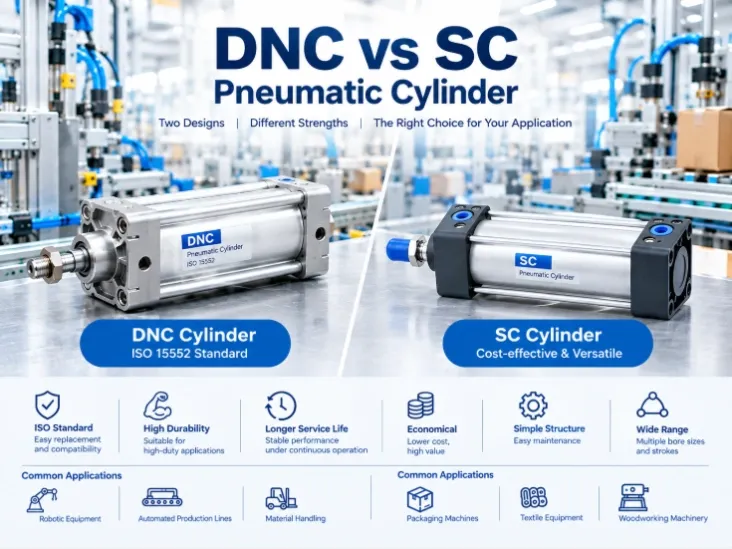
Long service life, consistent seals, dimensional interchangeability, sensors, CAD and application sizing.
Solenoid and directional valves
Core automation category; growth in compact manifolds, fieldbus and diagnostics.
Low power, fast response, reliable coils, voltage/connector options, manual override and manifold scalability.
Fittings and tubing
High-volume recurring demand; competitive and specification-sensitive.
Leak-free performance, stronger threads, virgin resin where applicable, tube compatibility, PT/NPT/G choice and batch consistency.
Air preparation
Benefits from maintenance, air-quality and efficiency programs.
Low pressure drop, visible status, easy element replacement, compact modularity and documented filtration.
Vacuum and gripping
Supported by robotics, electronics, packaging and material handling.
Low air consumption, fast release, compact integration, application-specific cups and end-of-arm tooling.
Smart pneumatics
Growing from a smaller base; definitions and forecasts vary.
IO-Link/fieldbus connectivity, pressure/flow sensing, remote diagnostics, condition monitoring and measurable savings.
Electric-pneumatic hybrid systems
Increasing as machine builders optimize each axis by function.
One supplier interface, matched controls, digital tools and freedom to combine electric precision with pneumatic simplicity.
6. Technology and Product Trends
Energy-managed pneumatics
Customers increasingly measure pressure, flow and idle consumption. Demand is moving toward automatic shutoff, leakage visibility, zoned pressure control, compact boosters and reduced-pressure operation.
Connectivity and diagnostics
IO-Link, fieldbus manifolds, wireless communication and connected sensors improve commissioning and provide data for preventive maintenance. Diagnostic value is often more important than adding connectivity to every component.
Compact and lightweight design
Smaller valves, compact cylinders and integrated manifolds reduce machine footprint, moving mass and air volume. This supports packaging, electronics, robotics and mobile end-effectors.
Long-life and predictive maintenance
Buyers want validated cycle life, wear-resistant seals, stable lubrication, clear maintenance intervals and failure-mode information. Sensor feedback and cycle counting support planned replacement.
Hygienic and industry-specific variants
Food, beverage, pharmaceutical and semiconductor customers require cleanability, compatible materials, controlled leakage, stainless options and stronger documentation.
Digital engineering
CAD models, online configurators, downloadable drawings and precise model-code logic shorten the customer’s design cycle and reduce quotation friction.
7. Energy Efficiency as a Buying Criterion
Compressed air is valuable because it is clean at the point of use, fast, simple and overload-tolerant; however, it is energy-intensive to generate. U.S. Department of Energy guidance emphasizes system-level management and identifies air leaks as a major loss source. Its compressed-air sourcebook notes that leaks can waste 20–30% of compressor output in poorly maintained systems.
This changes the commercial conversation. A supplier should document how a component reduces pressure drop, leakage, dead volume, switching energy or unnecessary air use. Even a modest purchase-price premium can be justified when the customer can calculate annual energy and downtime savings.
Customer problem
Product / solution response
Evidence to provide
Leakage and maintenance
Reliable fittings, quality tubing, improved seals, leak-testing practices
Leak test method, pressure range, tube tolerance, material specification
Excess system pressure
Precision regulators, local boosters, pressure zoning
Recommended operating pressure and flow curves
Idle air consumption
Air-management shutoff, monitored valves, vacuum optimization
Before/after flow data and control logic
Pressure loss
Correctly sized FRL units, valves, fittings and tubing
Cv/flow data, pressure-drop curves and sizing guide
Unplanned downtime
Long-life cylinders, diagnostic switches, replaceable wear items
Cycle testing, maintenance instructions and spare-part list
8. Competitive Landscape
The industry combines global full-line automation companies with strong regional manufacturers and specialist suppliers. Major names include SMC, Festo, Parker Hannifin, Emerson/Aventics, IMI Norgren, CKD, Camozzi, Airtac and other national or application-specific brands. The market is highly competitive, but not purely price-driven: availability, application engineering, digital selection tools and channel coverage strongly influence share.
Competitive tier
Typical strengths
Common vulnerability / opening
Global full-line leaders
Broad portfolio, engineering support, installed base, digital tools, global distribution
Higher prices; lead-time or customization gaps can create second-source opportunities.
Large regional brands
Strong local recognition, competitive price, regional logistics and broad standard range
Uneven global documentation or distributor reach.
Specialists
Deep performance in vacuum, valves, hygienic products, miniature motion or harsh environments
Narrow portfolio can limit one-stop sourcing.
Export-oriented OEM suppliers
Flexible customization, attractive cost, mixed-SKU supply and private label
Must prove consistency, documentation, traceability and service response.
9. Purchasing Priorities and Decision Criteria
Dimensional and functional interchangeability with established models
Stable quality across batches, supported by inspection records
Leakage performance, seal life and coil reliability
Correct PT, NPT or G thread standards and regional voltage options
Technical drawings, CAD files, certificates and clear model coding
Fast sample delivery and realistic production lead times
Mixed-SKU order capability and packaging suitable for distribution
Traceability, warranty handling and rapid technical response
Total operating cost, including energy, maintenance and downtime
10. High-Potential End Markets
Priority
End market
Why it matters
Best-fit offer
1
Packaging and processing
Large installed base; frequent motion, vacuum and valve use; recurring maintenance demand.
Cylinders, compact valves, fittings, tubing, vacuum, FRL and hygienic options.
2
General machinery / assembly
Broad OEM population and repeated standard components.
Interchangeable cylinders, 4V valves, manifolds, fittings, sensors and CAD support.
3
Electronics and semiconductors
High automation intensity; vacuum, cleanliness and compactness are important.
Miniature valves, clean air, vacuum, precision regulation, ionization and compact actuators.
4
Battery and EV manufacturing
Growing automation investment and specialized material/cleanliness requirements.
Copper/zinc-compatible or application-specific products, compact motion, vacuum and air management.
5
Food, beverage and pharmaceutical
Automation plus hygiene, washdown and documentation requirements.
Stainless/hygienic fittings, clean-air products, washdown actuators and process valves.
6
Maintenance, repair and operations
Recurring replacement demand and urgent availability needs.
Fast-moving standard SKUs, cross-reference support, kits and distributor stock programs.
11. Strategic Recommendations for Export-Oriented Suppliers
Build application pages, not only model pages: Create English pages for packaging, food processing, assembly, woodworking, semiconductor and maintenance applications. Link each application to a short, relevant SKU set.
Publish proof of quality: Show material specifications, wall thickness, thread quality, leakage testing, seal selection, lubrication and inspection procedures. Replace general “high quality” claims with evidence.
Create regional product variants: Maintain NPT and imperial content for North America, G threads and documentation for Europe, and PT/G choices for Asia and other markets. Offer DC24V as the primary industrial control voltage while retaining regional alternatives.
Sell energy and uptime: Use a simple worksheet to estimate leak cost, pressure savings, maintenance intervals and downtime reduction. Train sales staff to discuss total cost of ownership.
Develop distributor-ready assets: Provide Excel price lists, cross-reference tables, high-resolution images, dimensional drawings, CAD, barcodes, carton data and fast-moving SKU recommendations.
Use a sample-to-program sales process: Start with 10–20 high-frequency SKUs, validate samples, agree on inspection criteria, then expand to mixed orders and private-label programs.
Strengthen digital credibility: Ensure every priority product page includes a precise title, H1, specifications, model table, application guidance, FAQs, downloadable data and a direct quotation call to action.
12. Outlook to 2030
The base case is continued mid-single-digit global expansion with uneven annual performance. Pneumatics will remain important where speed, simplicity, hygiene, overload tolerance and favorable purchase cost matter. Electric actuation will continue to take share in axes requiring precise positioning, programmability or direct energy conversion, but the more common machine architecture will be hybrid rather than exclusively pneumatic or electric.
The strongest suppliers will combine reliable standard components with digital selection, energy-management capability and industry-specific engineering. Price will remain important—especially in fittings, tubing and standard cylinders—but documented quality, availability and application support will determine whether a supplier can win repeat OEM and distributor business.
13. Risk Factors
Weak capital investment or delayed machinery projects in Europe, China or automotive supply chains.
Tariffs, trade restrictions, currency volatility and regional sourcing requirements.
Substitution by electric actuators in positioning-intensive applications.
Commodity price pressure and aggressive competition in standardized SKUs.
Quality failures, leakage or inconsistent threads that damage distributor confidence.
Insufficient documentation for regulated, hygienic or high-technology markets.
Cybersecurity and interoperability requirements for connected pneumatic devices.
14. Sources and Recent Reports


Read next

Aug 17, 2026pneumatic cylinder

GLOBAL PNEUMATICS INDUSTRY REPORT

The global pneumatics industry is poised for steady growth, driven by industrial automation, energy efficiency, smart technologies, and rising demand for reliable, application-specific pneumatic solut

66643678-ca13-477b-94f8-3006b63536cc
GLOBAL PNEUMATICS INDUSTRY REPORT
Executive Summary
Core conclusion. The global pneumatics sector is experiencing a two-speed market: short-cycle industrial demand remains uneven in parts of Europe and mature manufacturing markets, while the structural drivers—automation, labor shortages, robotics, semiconductor investment, packaging, batteries, life sciences and energy optimization—remain intact.
Published 2025 market estimates differ materially because “pneumatic components” and “pneumatic equipment” are not standardized categories. Credible public estimates place the narrower components market near USD 14.8–17.7 billion, while broader equipment estimates cluster around USD 35 billion.
Most public forecasts imply mid-single-digit to high-single-digit annual growth through the early-to-mid 2030s. A prudent planning assumption is approximately 5–7% nominal CAGR, not a single precise figure.
Asia-Pacific is the largest demand center. One 2026 study assigns it 42.71% of 2025 pneumatic-component revenue; IFR reports that Asia received 74% of new industrial robot installations in 2024.
Energy efficiency has moved from a product benefit to a procurement requirement. Leak reduction, pressure optimization, smaller/lighter actuators, low-power valves, local pressure boosting and air-management systems are becoming major differentiators.
The winning product proposition is shifting from a standalone component to a documented solution: reliable hardware, full technical data, CAD, traceability, fast samples, stable lead times, thread/voltage customization and application support.
For export-oriented suppliers, the highest-potential offers are application bundles for packaging, food processing, general machine building, electronics/semiconductors, battery production and factory maintenance.
1. Scope and Methodology
This report synthesizes publicly accessible information from 2024–2026 market-research summaries, industry associations, automation statistics, company reports and energy-efficiency resources. It focuses on industrial pneumatic components and systems: actuators, directional valves, air preparation, fittings and tubing, vacuum products, sensors, manifolds, accessories and smart air-management solutions.
Important limitation. Market totals are not directly comparable unless the definition, geography, base year and included product categories are identical. This report therefore triangulates ranges and emphasizes direction, customer behavior and commercial implications rather than presenting one estimate as definitive.
2. Market Size and Growth Outlook
Public estimates confirm a sizable and expanding market, but they use different boundaries. The table below shows why market-definition discipline is essential.
Public source
2025 estimate
Forecast
Reported CAGR / note
Fortune Business Insights – pneumatic components
USD 14.81bn
USD 25.42bn by 2034
6.46%; Asia-Pacific 42.71% in 2025
Market Data Forecast – pneumatic components
USD 17.71bn
USD 28.38bn by 2034
5.38% for 2026–2034
Mordor Intelligence – pneumatic equipment
USD 34.99bn
USD 52.29bn by 2031
6.93% for 2026–2031
Fact.MR – pneumatic equipment
USD 36.2bn
USD 71.2bn by 2035
7.0% for 2025–2035
Custom Market Insights – pneumatic equipment
USD 34.9bn
USD 54.0bn by 2034
7.0% stated for 2025–2034
Planning interpretation: use USD 15–18 billion for a narrower component opportunity and roughly USD 35 billion for a broader equipment/system opportunity. For medium-term sales planning, a 5–7% nominal CAGR is defensible, but annual results will remain cyclical and regionally uneven.
3. Demand Environment: Structural Growth, Cyclical Pressure
3.1 Automation remains the primary structural driver
The International Federation of Robotics reported 542,000 industrial robots installed in 2024, more than double the annual volume ten years earlier. Installations exceeded 500,000 for the fourth consecutive year. Each automated cell creates demand for motion, gripping, vacuum, air preparation, valves, sensors, fittings and tubing—even when the principal robot axes are electric.
3.2 Short-cycle machinery demand is uneven
Current company and association indicators show a softer near-term environment. Festo reported 2025 sales of approximately EUR 3.33 billion, down 3.7%, while emphasizing continued integration of electric automation, pneumatics, digital functions and AI. VDMA also reported pressure in German robotics and automation and forecast a 5% revenue decline for that sector in 2026. These indicators do not negate long-term growth, but they favor suppliers with diversified industries, regions and customer types.
3.3 U.S. fluid-power conditions require quarterly monitoring
NFPA’s public updates show modest monthly fluctuations and have continued to publish customer-market forecasts covering fluid power, pneumatics and hydraulics. The practical implication for suppliers is to manage inventory carefully and combine annual market assumptions with monthly order and shipment signals.
4. Regional Outlook
Region
Current assessment
Commercial implications
Asia-Pacific
Largest production and demand center; strong robot, electronics, battery and general manufacturing footprint. IFR reports 74% of 2024 robot installations occurred in Asia.
Prioritize China, Japan, Korea, India and Southeast Asia. Offer compact products, fast delivery, manifold solutions and application-specific variants.
North America
Attractive automation, reshoring, packaging, logistics, food, semiconductor and maintenance demand; NPT compatibility and distributor support are essential.
Build U.S. distributor/OEM programs, maintain NPT options, publish imperial dimensions and provide rapid samples.
Europe
Advanced automation base and strong focus on energy, safety, documentation and sustainability, but machinery investment is currently uneven.
Compete on G threads, CE-related documentation, energy-saving evidence, traceability and reliability—not price alone.
Latin America
Opportunities in food, beverage, packaging, mining support and general industry; import procedures and distributor capability vary widely.
Use focused distributor partnerships, mixed-SKU orders, Spanish/Portuguese content and robust standard products.
Middle East & Africa
Selective growth in process industries, water, packaging, food and infrastructure; distributor-led market access is common.
Emphasize environmental suitability, spares availability and complete application packages.
5. Product-Segment Outlook
Segment
Demand outlook
What buyers increasingly expect
Pneumatic cylinders
Stable-to-growing; strong in packaging, assembly and general machinery.
Long service life, consistent seals, dimensional interchangeability, sensors, CAD and application sizing.
Solenoid and directional valves
Core automation category; growth in compact manifolds, fieldbus and diagnostics.
Low power, fast response, reliable coils, voltage/connector options, manual override and manifold scalability.
Fittings and tubing
High-volume recurring demand; competitive and specification-sensitive.
Leak-free performance, stronger threads, virgin resin where applicable, tube compatibility, PT/NPT/G choice and batch consistency.
Air preparation
Benefits from maintenance, air-quality and efficiency programs.
Low pressure drop, visible status, easy element replacement, compact modularity and documented filtration.
Vacuum and gripping
Supported by robotics, electronics, packaging and material handling.
Low air consumption, fast release, compact integration, application-specific cups and end-of-arm tooling.
Smart pneumatics
Growing from a smaller base; definitions and forecasts vary.
IO-Link/fieldbus connectivity, pressure/flow sensing, remote diagnostics, condition monitoring and measurable savings.
Electric-pneumatic hybrid systems
Increasing as machine builders optimize each axis by function.
One supplier interface, matched controls, digital tools and freedom to combine electric precision with pneumatic simplicity.
6. Technology and Product Trends
Energy-managed pneumatics
Customers increasingly measure pressure, flow and idle consumption. Demand is moving toward automatic shutoff, leakage visibility, zoned pressure control, compact boosters and reduced-pressure operation.
Connectivity and diagnostics
IO-Link, fieldbus manifolds, wireless communication and connected sensors improve commissioning and provide data for preventive maintenance. Diagnostic value is often more important than adding connectivity to every component.
Compact and lightweight design
Smaller valves, compact cylinders and integrated manifolds reduce machine footprint, moving mass and air volume. This supports packaging, electronics, robotics and mobile end-effectors.
Long-life and predictive maintenance
Buyers want validated cycle life, wear-resistant seals, stable lubrication, clear maintenance intervals and failure-mode information. Sensor feedback and cycle counting support planned replacement.
Hygienic and industry-specific variants
Food, beverage, pharmaceutical and semiconductor customers require cleanability, compatible materials, controlled leakage, stainless options and stronger documentation.
Digital engineering
CAD models, online configurators, downloadable drawings and precise model-code logic shorten the customer’s design cycle and reduce quotation friction.
7. Energy Efficiency as a Buying Criterion
Compressed air is valuable because it is clean at the point of use, fast, simple and overload-tolerant; however, it is energy-intensive to generate. U.S. Department of Energy guidance emphasizes system-level management and identifies air leaks as a major loss source. Its compressed-air sourcebook notes that leaks can waste 20–30% of compressor output in poorly maintained systems.
This changes the commercial conversation. A supplier should document how a component reduces pressure drop, leakage, dead volume, switching energy or unnecessary air use. Even a modest purchase-price premium can be justified when the customer can calculate annual energy and downtime savings.
Customer problem
Product / solution response
Evidence to provide
Leakage and maintenance
Reliable fittings, quality tubing, improved seals, leak-testing practices
Leak test method, pressure range, tube tolerance, material specification
Excess system pressure
Precision regulators, local boosters, pressure zoning
Recommended operating pressure and flow curves
Idle air consumption
Air-management shutoff, monitored valves, vacuum optimization
Before/after flow data and control logic
Pressure loss
Correctly sized FRL units, valves, fittings and tubing
Cv/flow data, pressure-drop curves and sizing guide
Unplanned downtime
Long-life cylinders, diagnostic switches, replaceable wear items
Cycle testing, maintenance instructions and spare-part list
8. Competitive Landscape
The industry combines global full-line automation companies with strong regional manufacturers and specialist suppliers. Major names include SMC, Festo, Parker Hannifin, Emerson/Aventics, IMI Norgren, CKD, Camozzi, Airtac and other national or application-specific brands. The market is highly competitive, but not purely price-driven: availability, application engineering, digital selection tools and channel coverage strongly influence share.
Competitive tier
Typical strengths
Common vulnerability / opening
Global full-line leaders
Broad portfolio, engineering support, installed base, digital tools, global distribution
Higher prices; lead-time or customization gaps can create second-source opportunities.
Large regional brands
Strong local recognition, competitive price, regional logistics and broad standard range
Uneven global documentation or distributor reach.
Specialists
Deep performance in vacuum, valves, hygienic products, miniature motion or harsh environments
Narrow portfolio can limit one-stop sourcing.
Export-oriented OEM suppliers
Flexible customization, attractive cost, mixed-SKU supply and private label
Must prove consistency, documentation, traceability and service response.
9. Purchasing Priorities and Decision Criteria
Dimensional and functional interchangeability with established models
Stable quality across batches, supported by inspection records
Leakage performance, seal life and coil reliability
Correct PT, NPT or G thread standards and regional voltage options
Technical drawings, CAD files, certificates and clear model coding
Fast sample delivery and realistic production lead times
Mixed-SKU order capability and packaging suitable for distribution
Traceability, warranty handling and rapid technical response
Total operating cost, including energy, maintenance and downtime
10. High-Potential End Markets
Priority
End market
Why it matters
Best-fit offer
1
Packaging and processing
Large installed base; frequent motion, vacuum and valve use; recurring maintenance demand.
Cylinders, compact valves, fittings, tubing, vacuum, FRL and hygienic options.
2
General machinery / assembly
Broad OEM population and repeated standard components.
Interchangeable cylinders, 4V valves, manifolds, fittings, sensors and CAD support.
3
Electronics and semiconductors
High automation intensity; vacuum, cleanliness and compactness are important.
Miniature valves, clean air, vacuum, precision regulation, ionization and compact actuators.
4
Battery and EV manufacturing
Growing automation investment and specialized material/cleanliness requirements.
Copper/zinc-compatible or application-specific products, compact motion, vacuum and air management.
5
Food, beverage and pharmaceutical
Automation plus hygiene, washdown and documentation requirements.
Stainless/hygienic fittings, clean-air products, washdown actuators and process valves.
6
Maintenance, repair and operations
Recurring replacement demand and urgent availability needs.
Fast-moving standard SKUs, cross-reference support, kits and distributor stock programs.
11. Strategic Recommendations for Export-Oriented Suppliers
Build application pages, not only model pages: Create English pages for packaging, food processing, assembly, woodworking, semiconductor and maintenance applications. Link each application to a short, relevant SKU set.
Publish proof of quality: Show material specifications, wall thickness, thread quality, leakage testing, seal selection, lubrication and inspection procedures. Replace general “high quality” claims with evidence.
Create regional product variants: Maintain NPT and imperial content for North America, G threads and documentation for Europe, and PT/G choices for Asia and other markets. Offer DC24V as the primary industrial control voltage while retaining regional alternatives.
Sell energy and uptime: Use a simple worksheet to estimate leak cost, pressure savings, maintenance intervals and downtime reduction. Train sales staff to discuss total cost of ownership.
Develop distributor-ready assets: Provide Excel price lists, cross-reference tables, high-resolution images, dimensional drawings, CAD, barcodes, carton data and fast-moving SKU recommendations.
Use a sample-to-program sales process: Start with 10–20 high-frequency SKUs, validate samples, agree on inspection criteria, then expand to mixed orders and private-label programs.
Strengthen digital credibility: Ensure every priority product page includes a precise title, H1, specifications, model table, application guidance, FAQs, downloadable data and a direct quotation call to action.
12. Outlook to 2030
The base case is continued mid-single-digit global expansion with uneven annual performance. Pneumatics will remain important where speed, simplicity, hygiene, overload tolerance and favorable purchase cost matter. Electric actuation will continue to take share in axes requiring precise positioning, programmability or direct energy conversion, but the more common machine architecture will be hybrid rather than exclusively pneumatic or electric.
The strongest suppliers will combine reliable standard components with digital selection, energy-management capability and industry-specific engineering. Price will remain important—especially in fittings, tubing and standard cylinders—but documented quality, availability and application support will determine whether a supplier can win repeat OEM and distributor business.
13. Risk Factors
Weak capital investment or delayed machinery projects in Europe, China or automotive supply chains.
Tariffs, trade restrictions, currency volatility and regional sourcing requirements.
Substitution by electric actuators in positioning-intensive applications.
Commodity price pressure and aggressive competition in standardized SKUs.
Quality failures, leakage or inconsistent threads that damage distributor confidence.
Insufficient documentation for regulated, hygienic or high-technology markets.
Cybersecurity and interoperability requirements for connected pneumatic devices.
14. Sources and Recent Reports

Aug 17, 2026pneumatic cylinder

GLOBAL PNEUMATICS INDUSTRY REPORT

The global pneumatics industry is poised for steady growth, driven by industrial automation, energy efficiency, smart technologies, and rising demand for reliable, application-specific pneumatic solut

66643678-ca13-477b-94f8-3006b63536cc
GLOBAL PNEUMATICS INDUSTRY REPORT
Executive Summary
Core conclusion. The global pneumatics sector is experiencing a two-speed market: short-cycle industrial demand remains uneven in parts of Europe and mature manufacturing markets, while the structural drivers—automation, labor shortages, robotics, semiconductor investment, packaging, batteries, life sciences and energy optimization—remain intact.
Published 2025 market estimates differ materially because “pneumatic components” and “pneumatic equipment” are not standardized categories. Credible public estimates place the narrower components market near USD 14.8–17.7 billion, while broader equipment estimates cluster around USD 35 billion.
Most public forecasts imply mid-single-digit to high-single-digit annual growth through the early-to-mid 2030s. A prudent planning assumption is approximately 5–7% nominal CAGR, not a single precise figure.
Asia-Pacific is the largest demand center. One 2026 study assigns it 42.71% of 2025 pneumatic-component revenue; IFR reports that Asia received 74% of new industrial robot installations in 2024.
Energy efficiency has moved from a product benefit to a procurement requirement. Leak reduction, pressure optimization, smaller/lighter actuators, low-power valves, local pressure boosting and air-management systems are becoming major differentiators.
The winning product proposition is shifting from a standalone component to a documented solution: reliable hardware, full technical data, CAD, traceability, fast samples, stable lead times, thread/voltage customization and application support.
For export-oriented suppliers, the highest-potential offers are application bundles for packaging, food processing, general machine building, electronics/semiconductors, battery production and factory maintenance.
1. Scope and Methodology
This report synthesizes publicly accessible information from 2024–2026 market-research summaries, industry associations, automation statistics, company reports and energy-efficiency resources. It focuses on industrial pneumatic components and systems: actuators, directional valves, air preparation, fittings and tubing, vacuum products, sensors, manifolds, accessories and smart air-management solutions.
Important limitation. Market totals are not directly comparable unless the definition, geography, base year and included product categories are identical. This report therefore triangulates ranges and emphasizes direction, customer behavior and commercial implications rather than presenting one estimate as definitive.
2. Market Size and Growth Outlook
Public estimates confirm a sizable and expanding market, but they use different boundaries. The table below shows why market-definition discipline is essential.
Public source
2025 estimate
Forecast
Reported CAGR / note
Fortune Business Insights – pneumatic components
USD 14.81bn
USD 25.42bn by 2034
6.46%; Asia-Pacific 42.71% in 2025
Market Data Forecast – pneumatic components
USD 17.71bn
USD 28.38bn by 2034
5.38% for 2026–2034
Mordor Intelligence – pneumatic equipment
USD 34.99bn
USD 52.29bn by 2031
6.93% for 2026–2031
Fact.MR – pneumatic equipment
USD 36.2bn
USD 71.2bn by 2035
7.0% for 2025–2035
Custom Market Insights – pneumatic equipment
USD 34.9bn
USD 54.0bn by 2034
7.0% stated for 2025–2034
Planning interpretation: use USD 15–18 billion for a narrower component opportunity and roughly USD 35 billion for a broader equipment/system opportunity. For medium-term sales planning, a 5–7% nominal CAGR is defensible, but annual results will remain cyclical and regionally uneven.
3. Demand Environment: Structural Growth, Cyclical Pressure
3.1 Automation remains the primary structural driver
The International Federation of Robotics reported 542,000 industrial robots installed in 2024, more than double the annual volume ten years earlier. Installations exceeded 500,000 for the fourth consecutive year. Each automated cell creates demand for motion, gripping, vacuum, air preparation, valves, sensors, fittings and tubing—even when the principal robot axes are electric.
3.2 Short-cycle machinery demand is uneven
Current company and association indicators show a softer near-term environment. Festo reported 2025 sales of approximately EUR 3.33 billion, down 3.7%, while emphasizing continued integration of electric automation, pneumatics, digital functions and AI. VDMA also reported pressure in German robotics and automation and forecast a 5% revenue decline for that sector in 2026. These indicators do not negate long-term growth, but they favor suppliers with diversified industries, regions and customer types.
3.3 U.S. fluid-power conditions require quarterly monitoring
NFPA’s public updates show modest monthly fluctuations and have continued to publish customer-market forecasts covering fluid power, pneumatics and hydraulics. The practical implication for suppliers is to manage inventory carefully and combine annual market assumptions with monthly order and shipment signals.
4. Regional Outlook
Region
Current assessment
Commercial implications
Asia-Pacific
Largest production and demand center; strong robot, electronics, battery and general manufacturing footprint. IFR reports 74% of 2024 robot installations occurred in Asia.
Prioritize China, Japan, Korea, India and Southeast Asia. Offer compact products, fast delivery, manifold solutions and application-specific variants.
North America
Attractive automation, reshoring, packaging, logistics, food, semiconductor and maintenance demand; NPT compatibility and distributor support are essential.
Build U.S. distributor/OEM programs, maintain NPT options, publish imperial dimensions and provide rapid samples.
Europe
Advanced automation base and strong focus on energy, safety, documentation and sustainability, but machinery investment is currently uneven.
Compete on G threads, CE-related documentation, energy-saving evidence, traceability and reliability—not price alone.
Latin America
Opportunities in food, beverage, packaging, mining support and general industry; import procedures and distributor capability vary widely.
Use focused distributor partnerships, mixed-SKU orders, Spanish/Portuguese content and robust standard products.
Middle East & Africa
Selective growth in process industries, water, packaging, food and infrastructure; distributor-led market access is common.
Emphasize environmental suitability, spares availability and complete application packages.
5. Product-Segment Outlook
Segment
Demand outlook
What buyers increasingly expect
Pneumatic cylinders
Stable-to-growing; strong in packaging, assembly and general machinery.
Long service life, consistent seals, dimensional interchangeability, sensors, CAD and application sizing.
Solenoid and directional valves
Core automation category; growth in compact manifolds, fieldbus and diagnostics.
Low power, fast response, reliable coils, voltage/connector options, manual override and manifold scalability.
Fittings and tubing
High-volume recurring demand; competitive and specification-sensitive.
Leak-free performance, stronger threads, virgin resin where applicable, tube compatibility, PT/NPT/G choice and batch consistency.
Air preparation
Benefits from maintenance, air-quality and efficiency programs.
Low pressure drop, visible status, easy element replacement, compact modularity and documented filtration.
Vacuum and gripping
Supported by robotics, electronics, packaging and material handling.
Low air consumption, fast release, compact integration, application-specific cups and end-of-arm tooling.
Smart pneumatics
Growing from a smaller base; definitions and forecasts vary.
IO-Link/fieldbus connectivity, pressure/flow sensing, remote diagnostics, condition monitoring and measurable savings.
Electric-pneumatic hybrid systems
Increasing as machine builders optimize each axis by function.
One supplier interface, matched controls, digital tools and freedom to combine electric precision with pneumatic simplicity.
6. Technology and Product Trends
Energy-managed pneumatics
Customers increasingly measure pressure, flow and idle consumption. Demand is moving toward automatic shutoff, leakage visibility, zoned pressure control, compact boosters and reduced-pressure operation.
Connectivity and diagnostics
IO-Link, fieldbus manifolds, wireless communication and connected sensors improve commissioning and provide data for preventive maintenance. Diagnostic value is often more important than adding connectivity to every component.
Compact and lightweight design
Smaller valves, compact cylinders and integrated manifolds reduce machine footprint, moving mass and air volume. This supports packaging, electronics, robotics and mobile end-effectors.
Long-life and predictive maintenance
Buyers want validated cycle life, wear-resistant seals, stable lubrication, clear maintenance intervals and failure-mode information. Sensor feedback and cycle counting support planned replacement.
Hygienic and industry-specific variants
Food, beverage, pharmaceutical and semiconductor customers require cleanability, compatible materials, controlled leakage, stainless options and stronger documentation.
Digital engineering
CAD models, online configurators, downloadable drawings and precise model-code logic shorten the customer’s design cycle and reduce quotation friction.
7. Energy Efficiency as a Buying Criterion
Compressed air is valuable because it is clean at the point of use, fast, simple and overload-tolerant; however, it is energy-intensive to generate. U.S. Department of Energy guidance emphasizes system-level management and identifies air leaks as a major loss source. Its compressed-air sourcebook notes that leaks can waste 20–30% of compressor output in poorly maintained systems.
This changes the commercial conversation. A supplier should document how a component reduces pressure drop, leakage, dead volume, switching energy or unnecessary air use. Even a modest purchase-price premium can be justified when the customer can calculate annual energy and downtime savings.
Customer problem
Product / solution response
Evidence to provide
Leakage and maintenance
Reliable fittings, quality tubing, improved seals, leak-testing practices
Leak test method, pressure range, tube tolerance, material specification
Excess system pressure
Precision regulators, local boosters, pressure zoning
Recommended operating pressure and flow curves
Idle air consumption
Air-management shutoff, monitored valves, vacuum optimization
Before/after flow data and control logic
Pressure loss
Correctly sized FRL units, valves, fittings and tubing
Cv/flow data, pressure-drop curves and sizing guide
Unplanned downtime
Long-life cylinders, diagnostic switches, replaceable wear items
Cycle testing, maintenance instructions and spare-part list
8. Competitive Landscape
The industry combines global full-line automation companies with strong regional manufacturers and specialist suppliers. Major names include SMC, Festo, Parker Hannifin, Emerson/Aventics, IMI Norgren, CKD, Camozzi, Airtac and other national or application-specific brands. The market is highly competitive, but not purely price-driven: availability, application engineering, digital selection tools and channel coverage strongly influence share.
Competitive tier
Typical strengths
Common vulnerability / opening
Global full-line leaders
Broad portfolio, engineering support, installed base, digital tools, global distribution
Higher prices; lead-time or customization gaps can create second-source opportunities.
Large regional brands
Strong local recognition, competitive price, regional logistics and broad standard range
Uneven global documentation or distributor reach.
Specialists
Deep performance in vacuum, valves, hygienic products, miniature motion or harsh environments
Narrow portfolio can limit one-stop sourcing.
Export-oriented OEM suppliers
Flexible customization, attractive cost, mixed-SKU supply and private label
Must prove consistency, documentation, traceability and service response.
9. Purchasing Priorities and Decision Criteria
Dimensional and functional interchangeability with established models
Stable quality across batches, supported by inspection records
Leakage performance, seal life and coil reliability
Correct PT, NPT or G thread standards and regional voltage options
Technical drawings, CAD files, certificates and clear model coding
Fast sample delivery and realistic production lead times
Mixed-SKU order capability and packaging suitable for distribution
Traceability, warranty handling and rapid technical response
Total operating cost, including energy, maintenance and downtime
10. High-Potential End Markets
Priority
End market
Why it matters
Best-fit offer
1
Packaging and processing
Large installed base; frequent motion, vacuum and valve use; recurring maintenance demand.
Cylinders, compact valves, fittings, tubing, vacuum, FRL and hygienic options.
2
General machinery / assembly
Broad OEM population and repeated standard components.
Interchangeable cylinders, 4V valves, manifolds, fittings, sensors and CAD support.
3
Electronics and semiconductors
High automation intensity; vacuum, cleanliness and compactness are important.
Miniature valves, clean air, vacuum, precision regulation, ionization and compact actuators.
4
Battery and EV manufacturing
Growing automation investment and specialized material/cleanliness requirements.
Copper/zinc-compatible or application-specific products, compact motion, vacuum and air management.
5
Food, beverage and pharmaceutical
Automation plus hygiene, washdown and documentation requirements.
Stainless/hygienic fittings, clean-air products, washdown actuators and process valves.
6
Maintenance, repair and operations
Recurring replacement demand and urgent availability needs.
Fast-moving standard SKUs, cross-reference support, kits and distributor stock programs.
11. Strategic Recommendations for Export-Oriented Suppliers
Build application pages, not only model pages: Create English pages for packaging, food processing, assembly, woodworking, semiconductor and maintenance applications. Link each application to a short, relevant SKU set.
Publish proof of quality: Show material specifications, wall thickness, thread quality, leakage testing, seal selection, lubrication and inspection procedures. Replace general “high quality” claims with evidence.
Create regional product variants: Maintain NPT and imperial content for North America, G threads and documentation for Europe, and PT/G choices for Asia and other markets. Offer DC24V as the primary industrial control voltage while retaining regional alternatives.
Sell energy and uptime: Use a simple worksheet to estimate leak cost, pressure savings, maintenance intervals and downtime reduction. Train sales staff to discuss total cost of ownership.
Develop distributor-ready assets: Provide Excel price lists, cross-reference tables, high-resolution images, dimensional drawings, CAD, barcodes, carton data and fast-moving SKU recommendations.
Use a sample-to-program sales process: Start with 10–20 high-frequency SKUs, validate samples, agree on inspection criteria, then expand to mixed orders and private-label programs.
Strengthen digital credibility: Ensure every priority product page includes a precise title, H1, specifications, model table, application guidance, FAQs, downloadable data and a direct quotation call to action.
12. Outlook to 2030
The base case is continued mid-single-digit global expansion with uneven annual performance. Pneumatics will remain important where speed, simplicity, hygiene, overload tolerance and favorable purchase cost matter. Electric actuation will continue to take share in axes requiring precise positioning, programmability or direct energy conversion, but the more common machine architecture will be hybrid rather than exclusively pneumatic or electric.
The strongest suppliers will combine reliable standard components with digital selection, energy-management capability and industry-specific engineering. Price will remain important—especially in fittings, tubing and standard cylinders—but documented quality, availability and application support will determine whether a supplier can win repeat OEM and distributor business.
13. Risk Factors
Weak capital investment or delayed machinery projects in Europe, China or automotive supply chains.
Tariffs, trade restrictions, currency volatility and regional sourcing requirements.
Substitution by electric actuators in positioning-intensive applications.
Commodity price pressure and aggressive competition in standardized SKUs.
Quality failures, leakage or inconsistent threads that damage distributor confidence.
Insufficient documentation for regulated, hygienic or high-technology markets.
Cybersecurity and interoperability requirements for connected pneumatic devices.
14. Sources and Recent Reports


Recommended articles

Guides visitors may want next

Helpful guides, field notes, and stories for choosing with more context.