
Sep 5, 2026pneumatic cylinder

Pneumatic Cylinder vs Hydraulic Cylinder: Which One Is Right for Your Application?

Pneumatic cylinder or a hydraulic cylinder,understanding their differences can help improve machine performance, reduce maintenance costs, and increase production efficiency.
76590109-54af-4be6-9c27-30d7ad0476e4
Pneumatic Cylinder vs Hydraulic Cylinder: Which One Is Right for Your Application?
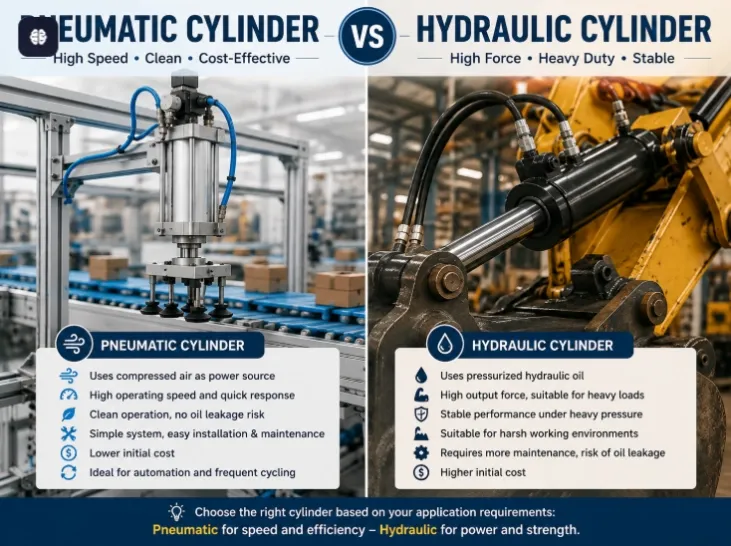
When designing an industrial automation system, one of the first decisions engineers face is whether to use a pneumatic cylinder or a hydraulic cylinder. Both devices convert fluid power into linear motion, but they operate on different principles and are suited to different working environments. Understanding their differences can help improve machine performance, reduce maintenance costs, and increase production efficiency.

Working Principle

A pneumatic cylinder uses compressed air as its power source. Air enters the cylinder chamber, pushing the piston to create linear movement. Once the air is released, the piston returns with the help of compressed air or a spring, depending on the cylinder type.
A hydraulic cylinder, on the other hand, is powered by pressurized hydraulic oil. Because hydraulic fluid is almost incompressible, it can generate much higher output force than compressed air, making it suitable for heavy-duty applications.

Output Force

The biggest difference between pneumatic and hydraulic cylinders is their force capability.
Hydraulic cylinders are designed for applications that require high pushing or lifting forces, such as construction machinery, hydraulic presses, and heavy industrial equipment.
Pneumatic cylinders provide lower output force but offer fast response and consistent motion, making them ideal for automation systems where speed is more important than maximum force.

Speed and Efficiency

Pneumatic cylinders generally operate at higher speeds. Since compressed air flows quickly through pneumatic valves and pipelines, cylinders can complete repeated movements in a short time. This makes them an excellent choice for packaging machines, pick-and-place systems, assembly lines, and material handling equipment.
Hydraulic cylinders usually move more slowly, but they provide smoother motion under heavy loads and maintain stable force throughout the stroke.

Cleanliness and Maintenance

Compressed air is clean and does not contaminate products if a minor leak occurs. This makes pneumatic systems widely used in industries such as food processing, electronics, pharmaceuticals, and medical equipment.
Hydraulic systems require hydraulic oil, and oil leakage can create safety hazards, increase maintenance costs, and contaminate the working environment. Regular inspection of seals, hoses, and hydraulic fluid is therefore essential.

Installation Cost

A pneumatic system is typically simpler to install. It usually consists of an air compressor, FRL unit, solenoid valves, pneumatic fittings, tubing, and cylinders. The components are lightweight, easy to replace, and relatively inexpensive.
Hydraulic systems require additional equipment, including hydraulic pumps, oil tanks, filters, valves, and high-pressure hoses. As a result, the initial investment and maintenance costs are generally higher.

Typical Applications

Pneumatic cylinders are commonly used in:
  • Packaging machinery
  • Factory automation
  • Assembly equipment
  • Textile machinery
  • Electronic manufacturing
  • Pick-and-place robots
  • Conveyor systems
Hydraulic cylinders are more suitable for:
  • Excavators
  • Agricultural machinery
  • Hydraulic presses
  • Injection molding machines
  • Mining equipment
  • Heavy lifting systems

Which One Should You Choose?

The best choice depends on your application rather than simply selecting the more powerful option.
If your equipment requires high speed, clean operation, low maintenance, and frequent cycling, a pneumatic cylinder is usually the better solution.
If your application involves heavy loads, high force, and precise load holding, a hydraulic cylinder is the preferred choice.
For most industrial automation equipment, pneumatic cylinders provide an excellent balance of performance, reliability, and cost. They are easy to integrate with solenoid valves, air preparation units, and pneumatic fittings, making them one of the most widely used actuators in modern manufacturing.
As automation continues to expand across industries, pneumatic cylinders remain the preferred choice for OEM machine builders looking for efficient, reliable, and economical linear motion solutions. Choosing the right cylinder at the design stage will help ensure stable operation, reduce downtime, and improve long-term productivity.
Read next

Sep 5, 2026pneumatic cylinder

Pneumatic Cylinder vs Hydraulic Cylinder: Which One Is Right for Your Application?

Pneumatic cylinder or a hydraulic cylinder,understanding their differences can help improve machine performance, reduce maintenance costs, and increase production efficiency.

76590109-54af-4be6-9c27-30d7ad0476e4
Pneumatic Cylinder vs Hydraulic Cylinder: Which One Is Right for Your Application?
When designing an industrial automation system, one of the first decisions engineers face is whether to use a pneumatic cylinder or a hydraulic cylinder. Both devices convert fluid power into linear motion, but they operate on different principles and are suited to different working environments. Understanding their differences can help improve machine performance, reduce maintenance costs, and increase production efficiency.

Working Principle

A pneumatic cylinder uses compressed air as its power source. Air enters the cylinder chamber, pushing the piston to create linear movement. Once the air is released, the piston returns with the help of compressed air or a spring, depending on the cylinder type.
A hydraulic cylinder, on the other hand, is powered by pressurized hydraulic oil. Because hydraulic fluid is almost incompressible, it can generate much higher output force than compressed air, making it suitable for heavy-duty applications.

Output Force

The biggest difference between pneumatic and hydraulic cylinders is their force capability.
Hydraulic cylinders are designed for applications that require high pushing or lifting forces, such as construction machinery, hydraulic presses, and heavy industrial equipment.
Pneumatic cylinders provide lower output force but offer fast response and consistent motion, making them ideal for automation systems where speed is more important than maximum force.

Speed and Efficiency

Pneumatic cylinders generally operate at higher speeds. Since compressed air flows quickly through pneumatic valves and pipelines, cylinders can complete repeated movements in a short time. This makes them an excellent choice for packaging machines, pick-and-place systems, assembly lines, and material handling equipment.
Hydraulic cylinders usually move more slowly, but they provide smoother motion under heavy loads and maintain stable force throughout the stroke.

Cleanliness and Maintenance

Compressed air is clean and does not contaminate products if a minor leak occurs. This makes pneumatic systems widely used in industries such as food processing, electronics, pharmaceuticals, and medical equipment.
Hydraulic systems require hydraulic oil, and oil leakage can create safety hazards, increase maintenance costs, and contaminate the working environment. Regular inspection of seals, hoses, and hydraulic fluid is therefore essential.

Installation Cost

A pneumatic system is typically simpler to install. It usually consists of an air compressor, FRL unit, solenoid valves, pneumatic fittings, tubing, and cylinders. The components are lightweight, easy to replace, and relatively inexpensive.
Hydraulic systems require additional equipment, including hydraulic pumps, oil tanks, filters, valves, and high-pressure hoses. As a result, the initial investment and maintenance costs are generally higher.

Typical Applications

Pneumatic cylinders are commonly used in:
  • Packaging machinery
  • Factory automation
  • Assembly equipment
  • Textile machinery
  • Electronic manufacturing
  • Pick-and-place robots
  • Conveyor systems
Hydraulic cylinders are more suitable for:
  • Excavators
  • Agricultural machinery
  • Hydraulic presses
  • Injection molding machines
  • Mining equipment
  • Heavy lifting systems

Which One Should You Choose?

The best choice depends on your application rather than simply selecting the more powerful option.
If your equipment requires high speed, clean operation, low maintenance, and frequent cycling, a pneumatic cylinder is usually the better solution.
If your application involves heavy loads, high force, and precise load holding, a hydraulic cylinder is the preferred choice.
For most industrial automation equipment, pneumatic cylinders provide an excellent balance of performance, reliability, and cost. They are easy to integrate with solenoid valves, air preparation units, and pneumatic fittings, making them one of the most widely used actuators in modern manufacturing.
As automation continues to expand across industries, pneumatic cylinders remain the preferred choice for OEM machine builders looking for efficient, reliable, and economical linear motion solutions. Choosing the right cylinder at the design stage will help ensure stable operation, reduce downtime, and improve long-term productivity.


Sep 5, 2026pneumatic cylinder

Pneumatic Cylinder vs Hydraulic Cylinder: Which One Is Right for Your Application?

Pneumatic cylinder or a hydraulic cylinder,understanding their differences can help improve machine performance, reduce maintenance costs, and increase production efficiency.

76590109-54af-4be6-9c27-30d7ad0476e4
Pneumatic Cylinder vs Hydraulic Cylinder: Which One Is Right for Your Application?
When designing an industrial automation system, one of the first decisions engineers face is whether to use a pneumatic cylinder or a hydraulic cylinder. Both devices convert fluid power into linear motion, but they operate on different principles and are suited to different working environments. Understanding their differences can help improve machine performance, reduce maintenance costs, and increase production efficiency.

Working Principle

A pneumatic cylinder uses compressed air as its power source. Air enters the cylinder chamber, pushing the piston to create linear movement. Once the air is released, the piston returns with the help of compressed air or a spring, depending on the cylinder type.
A hydraulic cylinder, on the other hand, is powered by pressurized hydraulic oil. Because hydraulic fluid is almost incompressible, it can generate much higher output force than compressed air, making it suitable for heavy-duty applications.

Output Force

The biggest difference between pneumatic and hydraulic cylinders is their force capability.
Hydraulic cylinders are designed for applications that require high pushing or lifting forces, such as construction machinery, hydraulic presses, and heavy industrial equipment.
Pneumatic cylinders provide lower output force but offer fast response and consistent motion, making them ideal for automation systems where speed is more important than maximum force.

Speed and Efficiency

Pneumatic cylinders generally operate at higher speeds. Since compressed air flows quickly through pneumatic valves and pipelines, cylinders can complete repeated movements in a short time. This makes them an excellent choice for packaging machines, pick-and-place systems, assembly lines, and material handling equipment.
Hydraulic cylinders usually move more slowly, but they provide smoother motion under heavy loads and maintain stable force throughout the stroke.

Cleanliness and Maintenance

Compressed air is clean and does not contaminate products if a minor leak occurs. This makes pneumatic systems widely used in industries such as food processing, electronics, pharmaceuticals, and medical equipment.
Hydraulic systems require hydraulic oil, and oil leakage can create safety hazards, increase maintenance costs, and contaminate the working environment. Regular inspection of seals, hoses, and hydraulic fluid is therefore essential.

Installation Cost

A pneumatic system is typically simpler to install. It usually consists of an air compressor, FRL unit, solenoid valves, pneumatic fittings, tubing, and cylinders. The components are lightweight, easy to replace, and relatively inexpensive.
Hydraulic systems require additional equipment, including hydraulic pumps, oil tanks, filters, valves, and high-pressure hoses. As a result, the initial investment and maintenance costs are generally higher.

Typical Applications

Pneumatic cylinders are commonly used in:
  • Packaging machinery
  • Factory automation
  • Assembly equipment
  • Textile machinery
  • Electronic manufacturing
  • Pick-and-place robots
  • Conveyor systems
Hydraulic cylinders are more suitable for:
  • Excavators
  • Agricultural machinery
  • Hydraulic presses
  • Injection molding machines
  • Mining equipment
  • Heavy lifting systems

Which One Should You Choose?

The best choice depends on your application rather than simply selecting the more powerful option.
If your equipment requires high speed, clean operation, low maintenance, and frequent cycling, a pneumatic cylinder is usually the better solution.
If your application involves heavy loads, high force, and precise load holding, a hydraulic cylinder is the preferred choice.
For most industrial automation equipment, pneumatic cylinders provide an excellent balance of performance, reliability, and cost. They are easy to integrate with solenoid valves, air preparation units, and pneumatic fittings, making them one of the most widely used actuators in modern manufacturing.
As automation continues to expand across industries, pneumatic cylinders remain the preferred choice for OEM machine builders looking for efficient, reliable, and economical linear motion solutions. Choosing the right cylinder at the design stage will help ensure stable operation, reduce downtime, and improve long-term productivity.


Recommended articles

Guides visitors may want next

Helpful guides, field notes, and stories for choosing with more context.