Aug 22, 2026pneumatic cylinder
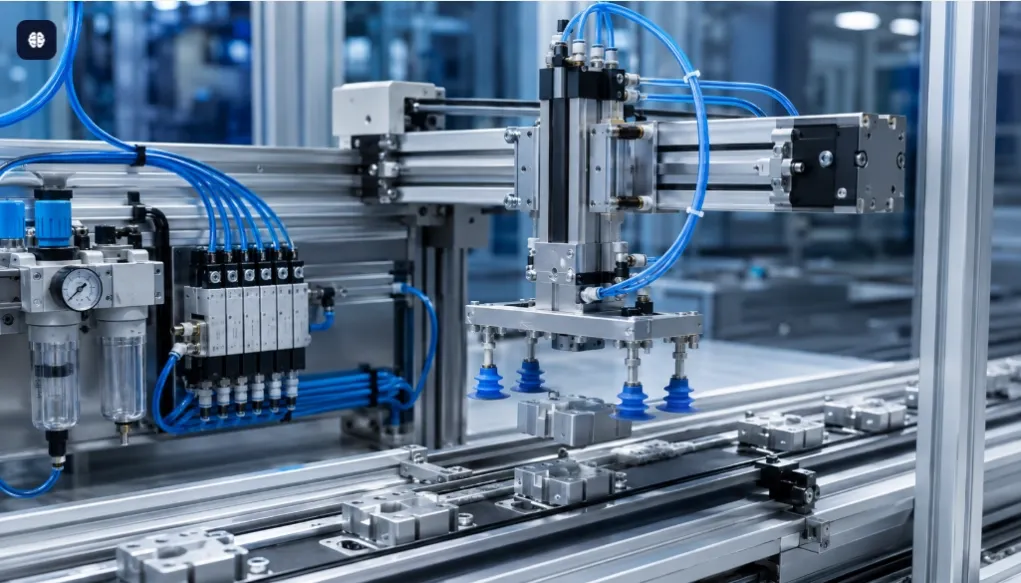
Pneumatic Solutions for Pick-and-Place Automation
Pneumatic solutions provide a fast, compact, and economical approach to pick-and-place automation.
Pneumatic Solutions for Pick-and-Place Automation
Pick-and-place automation is widely used in packaging, electronics, food processing, automotive manufacturing, pharmaceuticals, and general assembly. These systems pick up a workpiece, move it to another position, and release it accurately.
For high-speed and repetitive operations, pneumatic technology offers a reliable and cost-effective solution. Pneumatic cylinders, grippers, vacuum components, solenoid valves, sensors, fittings, and air preparation units can be combined into a compact system with fast response and simple maintenance.
Why Choose Pneumatic Pick-and-Place Systems?
Pneumatic systems are particularly suitable for applications involving repeated movement between fixed positions. Compared with complex motion-control systems, pneumatic equipment is generally easier to install, operate, and maintain.
Its main advantages include:
- Fast movement and short cycle times
- Compact design for limited spaces
- Reliable performance in repetitive operations
- Flexible linear, rotary, and gripping movements
- Easy integration with PLCs and sensors
- Simple maintenance and component replacement
- Competitive initial investment
When continuously programmable positioning is not required, pneumatics can provide an excellent balance between productivity, reliability, and operating cost.
Essential Pneumatic Components
Pneumatic Cylinders
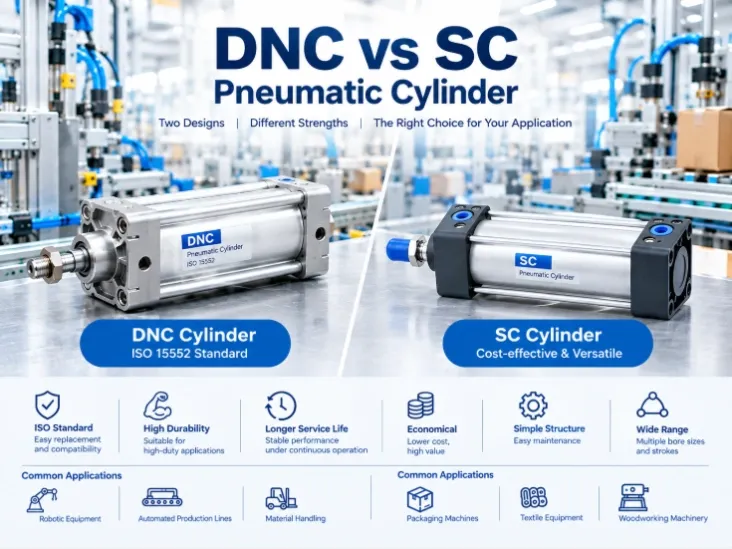
Pneumatic cylinders produce the horizontal and vertical movement in a pick-and-place machine. Common options include compact cylinders, guided cylinders, rodless cylinders, and standard profile cylinders.
Compact cylinders are ideal for restricted spaces. Guided cylinders provide better resistance to side loads and improve movement stability. Rodless cylinders are suitable for long strokes because they require less overall installation space.
Cylinder selection should consider the load weight, stroke, bore size, movement direction, operating pressure, cycle speed, and available mounting space. Vertical lifting applications should include an appropriate safety factor.
Pneumatic Grippers
Pneumatic grippers hold and release workpieces. Parallel grippers are commonly used for regularly shaped components, while angular grippers offer a wider opening range. Three-finger grippers are suitable for round parts requiring centered gripping.
The required gripping force depends on the weight, shape, surface, acceleration, and orientation of the workpiece. Insufficient force may allow the product to slip, while excessive force can damage fragile components.
Customized fingers and protective pads can improve grip stability when handling irregular, delicate, or finished surfaces.
Vacuum Generators and Suction Cups
Vacuum handling is ideal for flat, thin, smooth, or fragile products such as glass panels, sheet metal, plastic bags, cartons, and electronic components.
A vacuum system usually includes a vacuum generator, suction cup, filter, tubing, control valve, and vacuum switch. Flat cups are suitable for smooth surfaces, while bellows cups can compensate for height variations and slightly uneven products.
A vacuum sensor can confirm that the product has been securely picked up before movement begins, reducing the risk of dropped parts.
Solenoid Valves and Valve Manifolds
Solenoid valves control the airflow supplied to cylinders, grippers, and vacuum generators. Their flow capacity must match the actuator’s air consumption and speed requirements. An undersized valve may restrict airflow and reduce machine performance.
For machines with multiple actuators, a valve manifold can simplify piping and wiring, save installation space, and create a cleaner machine layout.
Air Preparation Equipment
Clean and stable compressed air is essential for reliable operation. A typical air preparation system includes a filter, regulator, pressure gauge, and, when required, a lubricator.
The filter removes moisture and solid particles, while the regulator maintains consistent pressure. Poor air quality can cause seal wear, valve sticking, corrosion, and unstable actuator movement.
Improving Speed, Accuracy, and Efficiency
Cylinder speed should be adjusted with flow-control fittings rather than simply increasing the air pressure. Shock absorbers or built-in cushioning can reduce impact at the end of the stroke, protecting the machine and workpiece.
Magnetic sensors installed on cylinders can confirm piston position and send signals to a PLC. This ensures that each movement is completed before the next operation begins.
Energy consumption can be reduced by:
- Selecting the correct cylinder bore
- Installing valves close to the actuators
- Minimizing tubing length
- Using the lowest effective pressure
- Regularly checking for air leaks
- Switching off the air supply during downtime
- Using energy-saving vacuum generators
Separate pressure settings can also be used for different operations. For example, a gripper may require lower pressure than a vertical lifting cylinder.
Safety and Maintenance
Vertical axes require special attention because the load may fall if air pressure is lost. Depending on the application, a rod lock, mechanical brake, pilot-operated check valve, or other load-holding device may be necessary.
Routine maintenance should include checking air leakage, tubing condition, loose fittings, cylinder seals, suction cup wear, filter contamination, sensor position, and valve response.
Preventive inspection helps reduce unexpected downtime and maintains stable pick-and-place performance.
Conclusion
Pneumatic solutions provide a fast, compact, and economical approach to pick-and-place automation. Properly selected cylinders, grippers, vacuum components, valves, sensors, fittings, and air treatment equipment can significantly improve machine productivity and reliability.
For the best results, engineers should evaluate force, speed, airflow, positioning requirements, energy consumption, safety, and operating conditions as a complete system. Working with an experienced pneumatic component supplier can help machine builders select compatible products, reduce design risks, and achieve stable long-term performance.