
Sep 3, 2026pneumatic cylinder

Why Pneumatic Cylinders Lose Force and How to Fix It

Pneumatic cylinder force loss is usually caused by insufficient pressure, air leakage, , or mechanical misalignment, and can be corrected through systematic systematic inspection, and proper sizing.
27bf3444-1272-406c-a513-e4c6f1951d08
Why Pneumatic Cylinders Lose Force and How to Fix It
A pneumatic cylinder that suddenly struggles to lift, clamp or push a load does not always need to be replaced. In many cases, the cylinder itself is still serviceable. The real problem may be low pressure at the cylinder, restricted airflow, internal leakage or poor mechanical alignment.
Finding the cause requires more than checking the pressure gauge beside the compressor. The pressure available while the cylinder is moving is what matters.

Check the Pressure Under Load

The force produced by a cylinder depends mainly on its effective piston area and the pressure acting on that area. If the pressure falls, the available force falls with it.
A regulator may show the correct setting while the machine is idle, but the pressure can drop sharply when several pneumatic devices operate at the same time. An undersized compressor, blocked filter, long tube or restrictive valve may prevent the system from maintaining pressure under load.
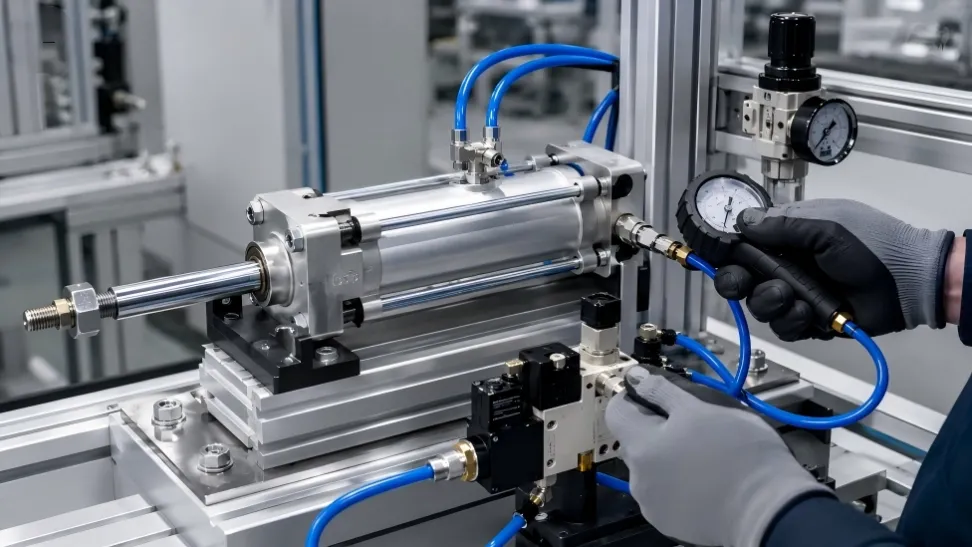
Install a pressure gauge close to the cylinder and observe it during operation. If the pressure drops while the piston moves, inspect the upstream air supply rather than replacing the cylinder.
The solution may involve cleaning the filter, adjusting the regulator, increasing the tube size or using a valve with greater flow capacity.

Look for External Air Leakage

Leaks waste compressed air and reduce the pressure available to the actuator. Common leakage points include tube connections, fittings, valve ports, rod seals and damaged tubing.
Apply a suitable leak-detection solution around the connections while the system is pressurized. Bubbles indicate escaping air. Tighten loose fittings correctly and replace damaged tube ends instead of repeatedly applying more thread sealant.
If air leaks around the piston rod, the rod seal may be worn or damaged. A scratched or corroded piston rod can quickly damage a new seal, so inspect the rod surface before repairing the cylinder.

Test for Internal Leakage

A worn piston seal allows air to pass between the two cylinder chambers. The leak may not be visible from outside, but the cylinder will produce less force and may move slowly or fail to hold its position.
To check a double-acting cylinder, move the piston to one end, isolate the machine safely and pressurize one port. Significant continuous airflow from the opposite port can indicate piston-seal leakage.
Internal leakage may require replacement of the piston seals or a complete cylinder rebuild. If the barrel is scratched or badly worn, replacing only the seals may provide a short-term improvement rather than a lasting repair.

Inspect the Valve, Silencer and Flow Controls

A cylinder needs adequate airflow as well as pressure. A partially closed speed controller, contaminated silencer or undersized solenoid valve can restrict flow.
This problem is especially noticeable with large-bore or high-speed cylinders. The cylinder may move normally without a load but stall when connected to the machine.
Check the valve flow rating, tubing diameter and fitting bore. Inspect silencers for oil, dust or condensed moisture. A blocked exhaust can create back pressure on the opposite side of the piston and reduce the net working force.

Check Mechanical Alignment

A pneumatic cylinder is designed to produce force along the centerline of its piston rod. Side loads and misalignment increase friction between the rod, bearing and seals.
Disconnect the cylinder from the load and operate it at low pressure. If it moves smoothly when disconnected but struggles after reconnection, the machine mechanism may be binding.
Realign the cylinder and driven component. Use a floating joint where minor alignment errors are unavoidable, and install an external linear guide for loads that create side force or bending moments.

Confirm the Cylinder Size

Sometimes the cylinder has not lost force—it was undersized from the beginning. Theoretical force calculations do not account fully for friction, pressure losses, acceleration or changing load conditions.
Retraction force is also lower than extension force because the piston rod reduces the effective pressure area.
When selecting a replacement, calculate the force required in both directions and include a reasonable safety factor. Increasing the system pressure beyond the cylinder’s rated limit is not a safe solution. A larger bore is usually the correct choice when the existing cylinder cannot provide sufficient force at the approved working pressure.

Use a Logical Troubleshooting Order

Start with the simplest checks: supply pressure, regulator setting, filter condition and visible leakage. Then inspect the valve, tubing, flow controls and exhaust. If the air supply is stable, test for internal leakage and mechanical binding.
This method avoids unnecessary cylinder replacement and usually identifies the real cause faster. Clean compressed air, correct alignment and properly sized components will help the cylinder deliver consistent force throughout its service life.

Read next

Sep 3, 2026pneumatic cylinder

Why Pneumatic Cylinders Lose Force and How to Fix It

Pneumatic cylinder force loss is usually caused by insufficient pressure, air leakage, , or mechanical misalignment, and can be corrected through systematic systematic inspection, and proper sizing.

27bf3444-1272-406c-a513-e4c6f1951d08
Why Pneumatic Cylinders Lose Force and How to Fix It
A pneumatic cylinder that suddenly struggles to lift, clamp or push a load does not always need to be replaced. In many cases, the cylinder itself is still serviceable. The real problem may be low pressure at the cylinder, restricted airflow, internal leakage or poor mechanical alignment.
Finding the cause requires more than checking the pressure gauge beside the compressor. The pressure available while the cylinder is moving is what matters.

Check the Pressure Under Load

The force produced by a cylinder depends mainly on its effective piston area and the pressure acting on that area. If the pressure falls, the available force falls with it.
A regulator may show the correct setting while the machine is idle, but the pressure can drop sharply when several pneumatic devices operate at the same time. An undersized compressor, blocked filter, long tube or restrictive valve may prevent the system from maintaining pressure under load.
Install a pressure gauge close to the cylinder and observe it during operation. If the pressure drops while the piston moves, inspect the upstream air supply rather than replacing the cylinder.
The solution may involve cleaning the filter, adjusting the regulator, increasing the tube size or using a valve with greater flow capacity.

Look for External Air Leakage

Leaks waste compressed air and reduce the pressure available to the actuator. Common leakage points include tube connections, fittings, valve ports, rod seals and damaged tubing.
Apply a suitable leak-detection solution around the connections while the system is pressurized. Bubbles indicate escaping air. Tighten loose fittings correctly and replace damaged tube ends instead of repeatedly applying more thread sealant.
If air leaks around the piston rod, the rod seal may be worn or damaged. A scratched or corroded piston rod can quickly damage a new seal, so inspect the rod surface before repairing the cylinder.

Test for Internal Leakage

A worn piston seal allows air to pass between the two cylinder chambers. The leak may not be visible from outside, but the cylinder will produce less force and may move slowly or fail to hold its position.
To check a double-acting cylinder, move the piston to one end, isolate the machine safely and pressurize one port. Significant continuous airflow from the opposite port can indicate piston-seal leakage.
Internal leakage may require replacement of the piston seals or a complete cylinder rebuild. If the barrel is scratched or badly worn, replacing only the seals may provide a short-term improvement rather than a lasting repair.

Inspect the Valve, Silencer and Flow Controls

A cylinder needs adequate airflow as well as pressure. A partially closed speed controller, contaminated silencer or undersized solenoid valve can restrict flow.
This problem is especially noticeable with large-bore or high-speed cylinders. The cylinder may move normally without a load but stall when connected to the machine.
Check the valve flow rating, tubing diameter and fitting bore. Inspect silencers for oil, dust or condensed moisture. A blocked exhaust can create back pressure on the opposite side of the piston and reduce the net working force.

Check Mechanical Alignment

A pneumatic cylinder is designed to produce force along the centerline of its piston rod. Side loads and misalignment increase friction between the rod, bearing and seals.
Disconnect the cylinder from the load and operate it at low pressure. If it moves smoothly when disconnected but struggles after reconnection, the machine mechanism may be binding.
Realign the cylinder and driven component. Use a floating joint where minor alignment errors are unavoidable, and install an external linear guide for loads that create side force or bending moments.

Confirm the Cylinder Size

Sometimes the cylinder has not lost force—it was undersized from the beginning. Theoretical force calculations do not account fully for friction, pressure losses, acceleration or changing load conditions.
Retraction force is also lower than extension force because the piston rod reduces the effective pressure area.
When selecting a replacement, calculate the force required in both directions and include a reasonable safety factor. Increasing the system pressure beyond the cylinder’s rated limit is not a safe solution. A larger bore is usually the correct choice when the existing cylinder cannot provide sufficient force at the approved working pressure.

Use a Logical Troubleshooting Order

Start with the simplest checks: supply pressure, regulator setting, filter condition and visible leakage. Then inspect the valve, tubing, flow controls and exhaust. If the air supply is stable, test for internal leakage and mechanical binding.
This method avoids unnecessary cylinder replacement and usually identifies the real cause faster. Clean compressed air, correct alignment and properly sized components will help the cylinder deliver consistent force throughout its service life.

Sep 3, 2026pneumatic cylinder

Why Pneumatic Cylinders Lose Force and How to Fix It

Pneumatic cylinder force loss is usually caused by insufficient pressure, air leakage, , or mechanical misalignment, and can be corrected through systematic systematic inspection, and proper sizing.

27bf3444-1272-406c-a513-e4c6f1951d08
Why Pneumatic Cylinders Lose Force and How to Fix It
A pneumatic cylinder that suddenly struggles to lift, clamp or push a load does not always need to be replaced. In many cases, the cylinder itself is still serviceable. The real problem may be low pressure at the cylinder, restricted airflow, internal leakage or poor mechanical alignment.
Finding the cause requires more than checking the pressure gauge beside the compressor. The pressure available while the cylinder is moving is what matters.

Check the Pressure Under Load

The force produced by a cylinder depends mainly on its effective piston area and the pressure acting on that area. If the pressure falls, the available force falls with it.
A regulator may show the correct setting while the machine is idle, but the pressure can drop sharply when several pneumatic devices operate at the same time. An undersized compressor, blocked filter, long tube or restrictive valve may prevent the system from maintaining pressure under load.
Install a pressure gauge close to the cylinder and observe it during operation. If the pressure drops while the piston moves, inspect the upstream air supply rather than replacing the cylinder.
The solution may involve cleaning the filter, adjusting the regulator, increasing the tube size or using a valve with greater flow capacity.

Look for External Air Leakage

Leaks waste compressed air and reduce the pressure available to the actuator. Common leakage points include tube connections, fittings, valve ports, rod seals and damaged tubing.
Apply a suitable leak-detection solution around the connections while the system is pressurized. Bubbles indicate escaping air. Tighten loose fittings correctly and replace damaged tube ends instead of repeatedly applying more thread sealant.
If air leaks around the piston rod, the rod seal may be worn or damaged. A scratched or corroded piston rod can quickly damage a new seal, so inspect the rod surface before repairing the cylinder.

Test for Internal Leakage

A worn piston seal allows air to pass between the two cylinder chambers. The leak may not be visible from outside, but the cylinder will produce less force and may move slowly or fail to hold its position.
To check a double-acting cylinder, move the piston to one end, isolate the machine safely and pressurize one port. Significant continuous airflow from the opposite port can indicate piston-seal leakage.
Internal leakage may require replacement of the piston seals or a complete cylinder rebuild. If the barrel is scratched or badly worn, replacing only the seals may provide a short-term improvement rather than a lasting repair.

Inspect the Valve, Silencer and Flow Controls

A cylinder needs adequate airflow as well as pressure. A partially closed speed controller, contaminated silencer or undersized solenoid valve can restrict flow.
This problem is especially noticeable with large-bore or high-speed cylinders. The cylinder may move normally without a load but stall when connected to the machine.
Check the valve flow rating, tubing diameter and fitting bore. Inspect silencers for oil, dust or condensed moisture. A blocked exhaust can create back pressure on the opposite side of the piston and reduce the net working force.

Check Mechanical Alignment

A pneumatic cylinder is designed to produce force along the centerline of its piston rod. Side loads and misalignment increase friction between the rod, bearing and seals.
Disconnect the cylinder from the load and operate it at low pressure. If it moves smoothly when disconnected but struggles after reconnection, the machine mechanism may be binding.
Realign the cylinder and driven component. Use a floating joint where minor alignment errors are unavoidable, and install an external linear guide for loads that create side force or bending moments.

Confirm the Cylinder Size

Sometimes the cylinder has not lost force—it was undersized from the beginning. Theoretical force calculations do not account fully for friction, pressure losses, acceleration or changing load conditions.
Retraction force is also lower than extension force because the piston rod reduces the effective pressure area.
When selecting a replacement, calculate the force required in both directions and include a reasonable safety factor. Increasing the system pressure beyond the cylinder’s rated limit is not a safe solution. A larger bore is usually the correct choice when the existing cylinder cannot provide sufficient force at the approved working pressure.

Use a Logical Troubleshooting Order

Start with the simplest checks: supply pressure, regulator setting, filter condition and visible leakage. Then inspect the valve, tubing, flow controls and exhaust. If the air supply is stable, test for internal leakage and mechanical binding.
This method avoids unnecessary cylinder replacement and usually identifies the real cause faster. Clean compressed air, correct alignment and properly sized components will help the cylinder deliver consistent force throughout its service life.


Recommended articles

Guides visitors may want next

Helpful guides, field notes, and stories for choosing with more context.