Aug 12, 2026pneumatic fittings
How Does a Pneumatic Silencer Reduce Exhaust Noise?
Pneumatic Muffler working principle
Pneumatic Muffler Working Principle: How Does a Pneumatic Silencer Reduce Exhaust Noise?
Pneumatic systems are widely used in industrial automation, packaging machinery, assembly equipment, robotics, and manufacturing lines. They are fast, reliable, and relatively simple to maintain.
However, pneumatic equipment can generate significant noise when compressed air is rapidly discharged from valves, cylinders, or other pneumatic components.
One of the simplest ways to reduce this noise is to install a pneumatic muffler, also known as a pneumatic silencer or air exhaust muffler.
But how does a pneumatic muffler work? Why can such a small component significantly reduce exhaust noise?
This article explains the working principle of pneumatic mufflers, their main types, applications, selection considerations, and maintenance requirements.
What Is a Pneumatic Muffler?
A pneumatic muffler is a small component installed on the exhaust port of a pneumatic valve or other compressed-air device to reduce the noise created when compressed air is released into the atmosphere.
Pneumatic mufflers are commonly installed on:
- Solenoid valves
- Pneumatic control valves
- Pneumatic cylinders and related circuits
- Air manifolds
- Vacuum equipment
- Other compressed-air exhaust ports
Depending on the application, pneumatic silencers can be manufactured from materials such as:
- Sintered brass
- Brass
- Engineering plastic
- Other porous materials
Their primary purpose is simple:
Reduce pneumatic exhaust noise while allowing discharged air to escape.
Why Does Pneumatic Exhaust Create Noise?
To understand the working principle of a pneumatic muffler, we first need to understand where the noise comes from.
Inside a pneumatic system, compressed air is stored and transported at a pressure higher than atmospheric pressure.
When a pneumatic valve switches, compressed air from the actuator or air circuit may be released rapidly through the exhaust port.
Without a muffler, this compressed air expands quickly into the atmosphere.
The rapid pressure change and high-velocity airflow create:
- Turbulence
- Pressure fluctuations
- High-velocity air jets
- Audible exhaust noise
The higher the airflow and pressure difference, the more noticeable the exhaust noise can become.
This is why solenoid valves operating repeatedly on high-speed automation equipment can produce significant noise.
How Does a Pneumatic Muffler Work?
The basic working principle of a pneumatic muffler is to diffuse and slow down the exhaust airflow before it enters the atmosphere.
Instead of allowing compressed air to discharge directly through a relatively concentrated exhaust opening, the muffler passes the air through many small passages or porous structures.
The process can be understood in four stages.
Step 1: Compressed Air Enters the Muffler
When the pneumatic valve exhausts, compressed air enters the muffler through its threaded connection.
Step 2: Air Passes Through a Porous Structure
Inside or around the muffler is a porous or specially designed exhaust element.
Instead of escaping through one concentrated opening, the exhaust air is distributed through many small passages.
Step 3: Airflow Velocity and Turbulence Are Reduced
As the exhaust air passes through these small passages, the concentrated air jet is diffused over a larger effective area.
This helps reduce the intensity of the exhaust airflow and associated turbulence.
Step 4: Air Is Released into the Atmosphere
The air finally exits the muffler at a lower and more distributed velocity than an unrestricted exhaust jet.
The result is quieter pneumatic exhaust.
A simplified flow path looks like this:
Pneumatic Valve → Exhaust Port → Muffler → Porous Element → Diffused Airflow → Atmosphere
How Does a Pneumatic Muffler Reduce Noise?
A pneumatic muffler does not simply "block" the sound.
Instead, it changes the way compressed air is discharged.
Without a muffler:
High-pressure air → Small exhaust port → High-speed jet → Strong turbulence → High noise
With a muffler:
High-pressure air → Porous muffler → Distributed airflow → Lower jet intensity → Reduced noise
This distinction is important because a properly selected muffler must achieve a balance between:
Noise reduction and sufficient exhaust airflow.
Restricting the exhaust too much can affect the performance of the pneumatic system.
Main Types of Pneumatic Mufflers
Different pneumatic systems require different muffler designs.
1. Sintered Brass Pneumatic Muffler
Sintered brass mufflers are among the most common types used in industrial pneumatic systems.
The porous sintered structure contains many small interconnected passages through which exhaust air can escape.
Advantages
- Good mechanical strength
- Compact construction
- Effective noise reduction
- Durable metal structure
- Suitable for many industrial environments
Typical Applications
- Solenoid valves
- Pneumatic control valves
- Industrial automation equipment
- Packaging machinery
2. Brass Pneumatic Muffler
Brass mufflers provide a strong metal construction and are suitable for industrial applications where durability is important.
They can be available in different designs and thread sizes to match various pneumatic exhaust ports.
Advantages
- High mechanical strength
- Good durability
- Reliable threaded connection
- Suitable for demanding industrial applications
3. Plastic Pneumatic Muffler
Plastic pneumatic mufflers provide a lightweight and economical alternative.
They are commonly used in general automation applications where extreme mechanical strength is not required.
Advantages
- Lightweight
- Corrosion resistant
- Easy to install
- Cost-effective
- Suitable for general automation systems
4. Adjustable Pneumatic Muffler
An adjustable muffler combines exhaust silencing with an adjustable restriction mechanism.
This allows the exhaust flow to be adjusted according to the pneumatic system requirements.
However, adjustment should be made carefully because excessive exhaust restriction can change actuator speed or create unwanted back pressure.
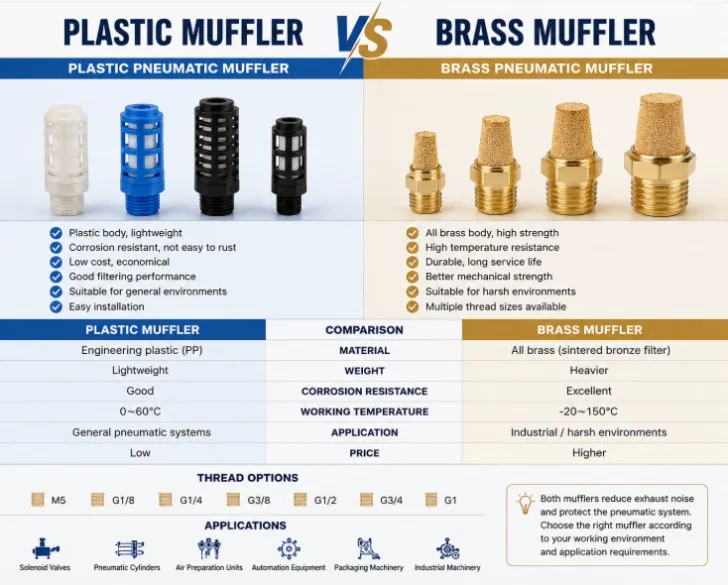
Plastic vs Brass Pneumatic Mufflers
The correct material depends on the working environment and system requirements.
Feature | Plastic Muffler | Brass Muffler |
Weight | Lightweight | Heavier |
Mechanical Strength | Moderate | High |
Corrosion Resistance | Good | Good |
Installation | Easy | Easy |
Durability | Good | Excellent |
Cost | Generally Lower | Generally Higher |
Typical Application | General Automation | Industrial / Demanding Applications |
Neither material is automatically better for every application.
The correct choice should depend on pressure, temperature, airflow, environment, thread size, and mechanical requirements.
Where Are Pneumatic Mufflers Used?
Pneumatic silencers can be found throughout industrial automation systems.
Solenoid Valves
This is one of the most common applications.
When a solenoid valve switches, air from the actuator circuit is discharged through the valve's exhaust port.
Installing a muffler at the exhaust port helps reduce the resulting noise.
Packaging Machinery
Packaging equipment often contains many pneumatic cylinders and valves operating continuously.
Typical machines include:
- Filling machines
- Sealing machines
- Labeling machines
- Cartoning machines
- Sorting systems
Multiple valves exhausting repeatedly can create considerable overall machine noise, making mufflers useful components in these systems.
Automated Production Lines
Pneumatic mufflers are also commonly used in:
- Assembly equipment
- Pick-and-place systems
- Material handling equipment
- Robotic systems
- Factory automation machinery
How to Choose the Right Pneumatic Muffler
Consider the following factors before selecting a pneumatic silencer.
1. Thread Size
The muffler thread must match the exhaust port.
Common pneumatic thread sizes may include:
- M5
- G1/8
- G1/4
- G3/8
- G1/2
- G3/4
- G1
Always confirm both thread size and thread standard before installation.
2. Exhaust Flow Requirement
Larger pneumatic cylinders and valves can require higher exhaust flow.
A muffler with insufficient flow capacity may restrict exhaust air and reduce actuator speed.
For higher-flow applications, select a muffler with sufficient exhaust capacity rather than simply choosing the smallest available model.
3. Working Pressure
Make sure the muffler is suitable for the operating conditions of the pneumatic system.
4. Operating Temperature
Material selection becomes particularly important when equipment operates at elevated or low temperatures.
Always check the manufacturer's specified temperature range.
5. Working Environment
Consider whether the muffler will be exposed to:
- Dust
- Oil mist
- Moisture
- Chemicals
- Mechanical impact
- High temperature
For more demanding industrial environments, a metal muffler may be preferable.
A Common Problem: Clogged Pneumatic Mufflers
One frequently overlooked maintenance issue is muffler contamination.
During operation, oil mist, dust, dirt, or other contaminants can gradually accumulate in the porous exhaust element.
As the muffler becomes clogged, exhaust resistance increases.
Possible symptoms include:
- Cylinder movement becomes slower
- Machine cycle time increases
- Exhaust performance decreases
- Back pressure increases
- Pneumatic equipment behaves differently from normal
If a pneumatic cylinder suddenly becomes slower, technicians often check the air pressure, cylinder, valve, and speed controller first.
Pneumatic Muffler Maintenance
Regular inspection can help maintain reliable system performance.
Recommended practices include:
- Inspect mufflers for contamination
- Check whether exhaust airflow has decreased
- Clean serviceable models according to the manufacturer's instructions
- Replace heavily clogged or damaged mufflers
- Investigate excessive oil or contamination in the compressed-air system
A muffler should not be treated as a permanent component that never requires inspection.
These two components are sometimes confused.
A pneumatic muffler is primarily designed to reduce exhaust noise.
Conclusion
The working principle of a pneumatic muffler is relatively simple but important.
When compressed air is discharged from a pneumatic system, the muffler passes the exhaust through a porous or specially designed flow path, helping diffuse the high-velocity air jet and reduce turbulence-related noise before the air reaches the atmosphere.
A properly selected pneumatic muffler can help provide:
- Lower exhaust noise
- A more comfortable working environment
- Compact pneumatic system design
- Reliable exhaust performance
However, engineers should consider more than noise reduction alone.
Thread size, exhaust flow capacity, pressure, temperature, material, and operating environment should all be considered when selecting a pneumatic muffler.
Regular inspection is also important because a clogged muffler can restrict airflow and negatively affect pneumatic system performance.