
Aug 27, 2026pneumatic fittings

How to Select the Right Pneumatic Fitting Size for Your Air System

Learn how to select pneumatic fitting sizes according to tube diameter, thread type, airflow, pressure and installation requirements
bc77d70a-5b6d-4bf5-81d0-ad80837e5d44

How to Select the Right Pneumatic Fitting Size for Your Air System

Selecting the correct pneumatic fitting size is essential for maintaining airflow, preventing leakage and ensuring reliable operation. A fitting that is too small can restrict flow and reduce actuator speed, while an incorrect thread or tube size may cause leakage or installation failure.

1. Identify the Pneumatic Tube Size

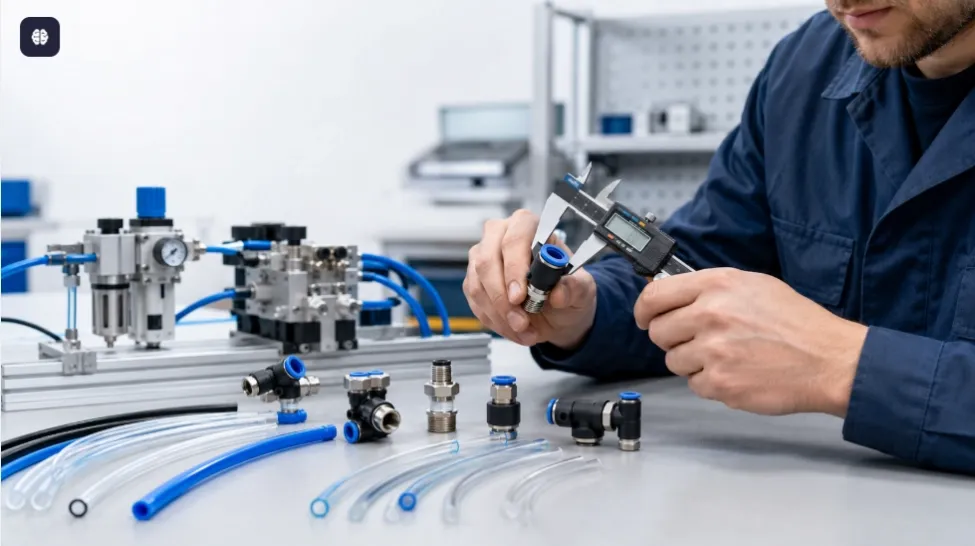
Begin by checking the outside diameter of the pneumatic tube. Push-in pneumatic fittings are normally selected according to tube outside diameter rather than inside diameter.
Common metric tube sizes include:
  • 4 mm
  • 6 mm
  • 8 mm
  • 10 mm
  • 12 mm
  • 16 mm
In inch-based systems, common sizes include 1/8, 1/4, 3/8 and 1/2 inch.
A 6 mm tube requires a fitting designed for a 6 mm outside diameter. Do not force an inch tube into a metric fitting, even when the dimensions appear similar. A small dimensional difference can prevent the sealing ring from gripping the tube correctly.

2. Confirm the Thread Type

Pneumatic fittings are commonly supplied with PT, NPT or G threads.
PT threads are tapered pipe threads frequently used in Asian pneumatic equipment. NPT threads are tapered threads widely used in North America. G threads, also known as BSPP threads, are parallel and normally require a sealing washer or O-ring.
The thread diameter alone is not enough to identify the standard. For example, a 1/4-inch PT thread and a 1/4-inch NPT thread have different thread angles and pitches. Mixing them may damage the port and cause leakage.
Always confirm the thread standard in the equipment manual or measure it with a thread gauge before ordering.

3. Consider Airflow Requirements

Tube and fitting size directly affect airflow. Small fittings may be sufficient for compact cylinders, sensors and low-flow control circuits. Larger cylinders, high-speed actuators and long air lines normally require larger tube diameters.
If an actuator moves too slowly even though the supply pressure is correct, restricted tubing or undersized fittings may be the cause. Select the fitting size according to required flow rate, cylinder bore, stroke frequency and tubing length.

4. Choose the Correct Fitting Configuration

Different installation positions require different fitting shapes:
  • PC straight male fittings for direct port connections
  • PL male elbow fittings for limited installation space
  • PU straight unions for joining two tubes
  • PV union elbows for 90-degree tube connections
  • PB bulkhead fittings for passing through a panel
  • PCF female fittings for connecting to male-threaded equipment
Swivel elbows are particularly useful when the tubing direction must be adjusted after installation.

5. Check Material and Working Conditions

Plastic push-in fittings are suitable for most general industrial automation systems. Nickel-plated brass fittings offer improved mechanical strength and are often preferred for demanding environments, frequent maintenance or exposed installations.
Verify that the fitting material, seal, pressure rating and temperature range are compatible with the compressed air and surrounding environment.
Correct fitting selection should balance tube size, thread standard, airflow and installation layout. When requesting a quotation, provide the tube outside diameter, thread type, port size, pressure and required fitting configuration. This helps the supplier recommend the correct model and reduces costly ordering mistakes.


Read next

Aug 27, 2026pneumatic fittings

How to Select the Right Pneumatic Fitting Size for Your Air System

Learn how to select pneumatic fitting sizes according to tube diameter, thread type, airflow, pressure and installation requirements

bc77d70a-5b6d-4bf5-81d0-ad80837e5d44

How to Select the Right Pneumatic Fitting Size for Your Air System

Selecting the correct pneumatic fitting size is essential for maintaining airflow, preventing leakage and ensuring reliable operation. A fitting that is too small can restrict flow and reduce actuator speed, while an incorrect thread or tube size may cause leakage or installation failure.

1. Identify the Pneumatic Tube Size

Begin by checking the outside diameter of the pneumatic tube. Push-in pneumatic fittings are normally selected according to tube outside diameter rather than inside diameter.
Common metric tube sizes include:
  • 4 mm
  • 6 mm
  • 8 mm
  • 10 mm
  • 12 mm
  • 16 mm
In inch-based systems, common sizes include 1/8, 1/4, 3/8 and 1/2 inch.
A 6 mm tube requires a fitting designed for a 6 mm outside diameter. Do not force an inch tube into a metric fitting, even when the dimensions appear similar. A small dimensional difference can prevent the sealing ring from gripping the tube correctly.

2. Confirm the Thread Type

Pneumatic fittings are commonly supplied with PT, NPT or G threads.
PT threads are tapered pipe threads frequently used in Asian pneumatic equipment. NPT threads are tapered threads widely used in North America. G threads, also known as BSPP threads, are parallel and normally require a sealing washer or O-ring.
The thread diameter alone is not enough to identify the standard. For example, a 1/4-inch PT thread and a 1/4-inch NPT thread have different thread angles and pitches. Mixing them may damage the port and cause leakage.
Always confirm the thread standard in the equipment manual or measure it with a thread gauge before ordering.

3. Consider Airflow Requirements

Tube and fitting size directly affect airflow. Small fittings may be sufficient for compact cylinders, sensors and low-flow control circuits. Larger cylinders, high-speed actuators and long air lines normally require larger tube diameters.
If an actuator moves too slowly even though the supply pressure is correct, restricted tubing or undersized fittings may be the cause. Select the fitting size according to required flow rate, cylinder bore, stroke frequency and tubing length.

4. Choose the Correct Fitting Configuration

Different installation positions require different fitting shapes:
  • PC straight male fittings for direct port connections
  • PL male elbow fittings for limited installation space
  • PU straight unions for joining two tubes
  • PV union elbows for 90-degree tube connections
  • PB bulkhead fittings for passing through a panel
  • PCF female fittings for connecting to male-threaded equipment
Swivel elbows are particularly useful when the tubing direction must be adjusted after installation.

5. Check Material and Working Conditions

Plastic push-in fittings are suitable for most general industrial automation systems. Nickel-plated brass fittings offer improved mechanical strength and are often preferred for demanding environments, frequent maintenance or exposed installations.
Verify that the fitting material, seal, pressure rating and temperature range are compatible with the compressed air and surrounding environment.
Correct fitting selection should balance tube size, thread standard, airflow and installation layout. When requesting a quotation, provide the tube outside diameter, thread type, port size, pressure and required fitting configuration. This helps the supplier recommend the correct model and reduces costly ordering mistakes.
Aug 27, 2026pneumatic fittings

How to Select the Right Pneumatic Fitting Size for Your Air System

Learn how to select pneumatic fitting sizes according to tube diameter, thread type, airflow, pressure and installation requirements

bc77d70a-5b6d-4bf5-81d0-ad80837e5d44

How to Select the Right Pneumatic Fitting Size for Your Air System

Selecting the correct pneumatic fitting size is essential for maintaining airflow, preventing leakage and ensuring reliable operation. A fitting that is too small can restrict flow and reduce actuator speed, while an incorrect thread or tube size may cause leakage or installation failure.

1. Identify the Pneumatic Tube Size

Begin by checking the outside diameter of the pneumatic tube. Push-in pneumatic fittings are normally selected according to tube outside diameter rather than inside diameter.
Common metric tube sizes include:
  • 4 mm
  • 6 mm
  • 8 mm
  • 10 mm
  • 12 mm
  • 16 mm
In inch-based systems, common sizes include 1/8, 1/4, 3/8 and 1/2 inch.
A 6 mm tube requires a fitting designed for a 6 mm outside diameter. Do not force an inch tube into a metric fitting, even when the dimensions appear similar. A small dimensional difference can prevent the sealing ring from gripping the tube correctly.

2. Confirm the Thread Type

Pneumatic fittings are commonly supplied with PT, NPT or G threads.
PT threads are tapered pipe threads frequently used in Asian pneumatic equipment. NPT threads are tapered threads widely used in North America. G threads, also known as BSPP threads, are parallel and normally require a sealing washer or O-ring.
The thread diameter alone is not enough to identify the standard. For example, a 1/4-inch PT thread and a 1/4-inch NPT thread have different thread angles and pitches. Mixing them may damage the port and cause leakage.
Always confirm the thread standard in the equipment manual or measure it with a thread gauge before ordering.

3. Consider Airflow Requirements

Tube and fitting size directly affect airflow. Small fittings may be sufficient for compact cylinders, sensors and low-flow control circuits. Larger cylinders, high-speed actuators and long air lines normally require larger tube diameters.
If an actuator moves too slowly even though the supply pressure is correct, restricted tubing or undersized fittings may be the cause. Select the fitting size according to required flow rate, cylinder bore, stroke frequency and tubing length.

4. Choose the Correct Fitting Configuration

Different installation positions require different fitting shapes:
  • PC straight male fittings for direct port connections
  • PL male elbow fittings for limited installation space
  • PU straight unions for joining two tubes
  • PV union elbows for 90-degree tube connections
  • PB bulkhead fittings for passing through a panel
  • PCF female fittings for connecting to male-threaded equipment
Swivel elbows are particularly useful when the tubing direction must be adjusted after installation.

5. Check Material and Working Conditions

Plastic push-in fittings are suitable for most general industrial automation systems. Nickel-plated brass fittings offer improved mechanical strength and are often preferred for demanding environments, frequent maintenance or exposed installations.
Verify that the fitting material, seal, pressure rating and temperature range are compatible with the compressed air and surrounding environment.
Correct fitting selection should balance tube size, thread standard, airflow and installation layout. When requesting a quotation, provide the tube outside diameter, thread type, port size, pressure and required fitting configuration. This helps the supplier recommend the correct model and reduces costly ordering mistakes.


Recommended articles

Guides visitors may want next

Helpful guides, field notes, and stories for choosing with more context.