
Aug 21, 2026pneumatic fittings

How to Select Pneumatic Components for Food Processing Equipment

Selecting pneumatic components for food-processing equipment requires a balance of performance, hygiene, cleanability, corrosion resistance, and maintenance.
9497cdf8-cf44-4dc6-9ea9-ebd480af09b0

How to Select Pneumatic Components for Food Processing Equipment

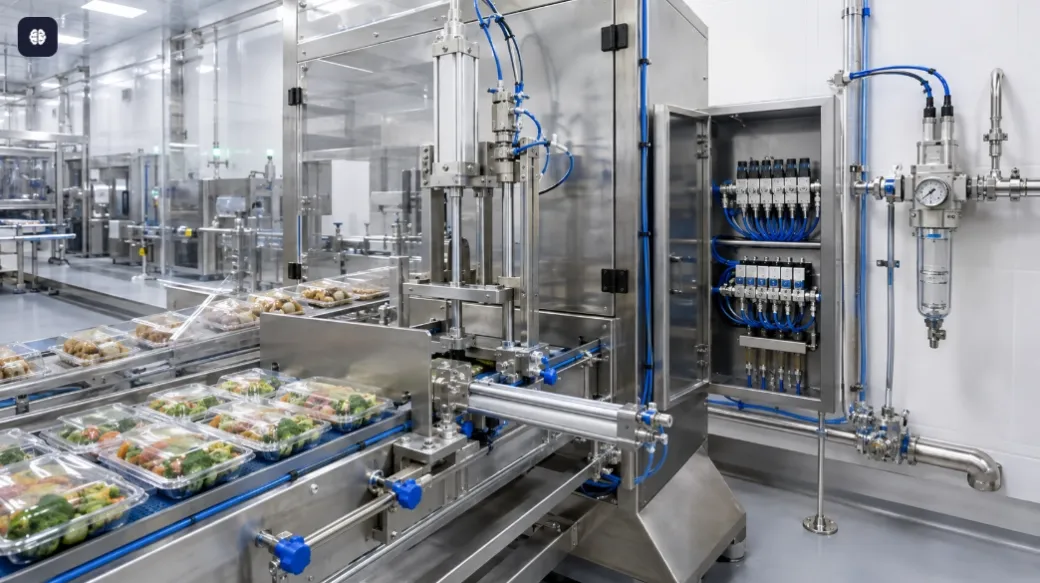
Pneumatic systems are widely used in food-processing and packaging equipment for filling, sorting, clamping, cutting, transferring, sealing, labeling, and product rejection. Pneumatic cylinders, solenoid valves, fittings, tubing, and air-preparation units are fast, compact, and relatively easy to maintain.
However, selecting pneumatic components for food machinery requires more than checking pressure, flow, and connection size. Engineers must also consider hygiene, corrosion resistance, cleaning chemicals, washdown conditions, compressed-air quality, and contamination risk.
This guide explains the most important factors when selecting pneumatic components for reliable food-processing equipment.

1. Define the Hygiene Zone

Begin by determining where each component will be installed.

Direct Food-Contact Zone

Components in this area may touch food or a surface from which food could return to the product. They generally require food-compatible materials, smooth surfaces, appropriate seals, approved lubricants, and documented compliance.
Standard industrial pneumatic products should not be assumed suitable for direct food contact unless their manufacturer confirms the intended use.

Splash or Indirect-Contact Zone

Components may be exposed to food splashes, cleaning water, detergent, or sanitizer without normally touching the food.
Priorities include:
  • Corrosion-resistant materials
  • Washdown-resistant construction
  • Sealed electrical connections
  • Chemical-resistant seals and tubing
  • Easily cleaned exterior surfaces

Non-Food Zone

Standard industrial components may be suitable in protected areas, provided that exhaust air, leaking oil, or damaged tubing cannot contaminate the product.
Whenever possible, locate valve manifolds and air-treatment equipment outside the main washdown area.

2. Evaluate the Operating and Cleaning Environment

Food factories may contain water, steam, salt, sugar, acids, oils, powders, and aggressive cleaning chemicals.
Before selecting a component, identify:
  • Ambient and product temperatures
  • Humidity and condensation
  • Washdown frequency
  • Water pressure and temperature
  • Cleaning chemicals and concentrations
  • Exposure to salt, acid, fat, or powder
  • Direct and indirect food-contact risks
Cleaning conditions can be more severe than normal production. A component that tolerates occasional water splashes may not withstand daily high-pressure, high-temperature washdown.

3. Select Corrosion-Resistant Materials

Standard plated steel may corrode rapidly in wet food-processing environments.
Depending on the application, suitable materials may include:
  • Stainless steel
  • Anodized aluminum
  • Nickel-plated brass
  • Corrosion-resistant engineering plastics
  • Chemically resistant elastomers
Stainless steel is often selected for wet or exposed areas because it offers good corrosion resistance and cleanability. However, the appropriate stainless-steel grade should be chosen according to exposure to chlorine, salt, food acids, and detergents.
Nickel-plated brass is commonly used for pneumatic fittings, while anodized aluminum may be suitable for protected machine areas.
Always confirm material compatibility with the cleaning-chemical supplier.

4. Choose the Correct Pneumatic Cylinder

Pneumatic cylinders in food machinery may push, lift, clamp, reject, or position products and machine components.
Selection factors include:
  • Required force
  • Bore and stroke
  • Operating pressure
  • Speed and cycle frequency
  • Mounting space
  • Side load
  • Temperature
  • Washdown exposure
  • Seal compatibility
For wet or corrosive environments, consider stainless-steel piston rods, corrosion-resistant bodies, special seals, rod scrapers, or protective boots.
A standard cylinder should provide axial force only. External guide rails or guided cylinders should support side loads and moments. Correct alignment reduces seal wear and prevents premature air leakage.
Theoretical cylinder force can be estimated as:
Cylinder Force = Air Pressure × Effective Piston Area
Because friction and pressure losses reduce actual force, include an appropriate safety margin.

5. Select Solenoid Valves by Function and Environment

Common valve configurations include:
  • 3/2-way valves for single-acting cylinders and air-blow circuits
  • 5/2-way valves for double-acting cylinders
  • 5/3-way valves when a defined center condition is required
  • 2/2-way valves for basic air isolation
Valve selection should consider flow capacity, port size, pressure, response time, coil voltage, fail-safe state, electrical protection, and chemical exposure.
Whenever practical, install solenoid valves and manifolds inside a protected cabinet. Remote installation reduces water exposure, corrosion, electrical faults, and contamination risk.
Valves installed near the process require sealed connectors and protection suitable for the actual washdown procedure.

6. Select Suitable Tubing and Fittings

Pneumatic tubing must resist pressure, repeated movement, temperature, cleaning chemicals, and abrasion.
Common materials include:
  • Polyurethane: Flexible with a small bending radius
  • Nylon: Strong with good pressure resistance
  • PTFE: Resistant to many chemicals and higher temperatures
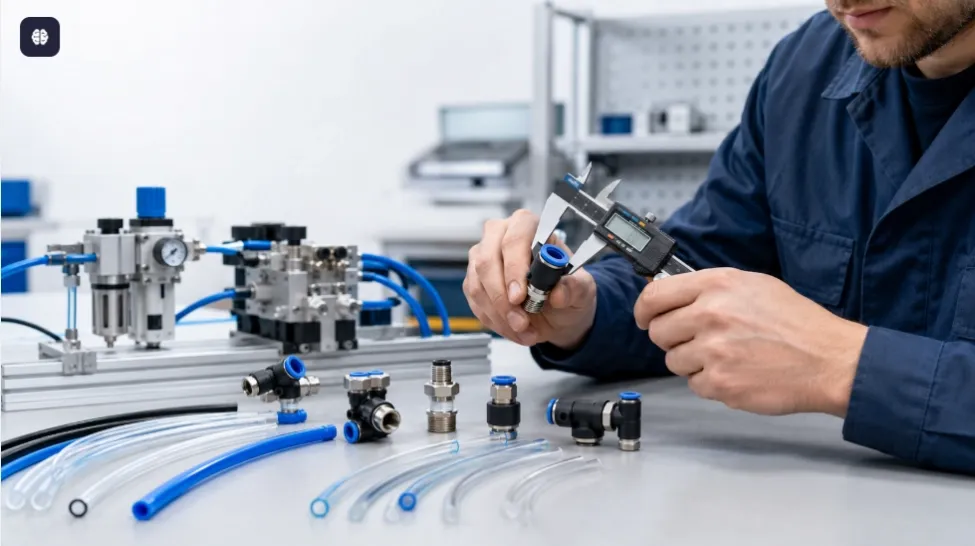
Confirm the tube’s outside diameter, inside diameter, working pressure, temperature range, chemical compatibility, and food-contact documentation where applicable.
Fittings should provide reliable sealing under vibration and repeated cleaning. Stainless-steel and nickel-plated brass fittings are commonly considered for corrosion resistance.
Confirm the correct thread standard, such as G, R, PT, NPT, or metric. Similar-looking threads are not always interchangeable.
Minimize unnecessary elbows and adapters to reduce leakage points, pressure loss, and difficult-to-clean areas.

7. Provide Clean and Dry Compressed Air

Compressed air may contain dust, rust, water, compressor oil, and microorganisms. Required air quality depends on how the air is used.
General actuator circuits may use standard filtration and moisture separation. If exhaust air can reach food or packaging interiors, finer filtration and oil control may be required.
Air used directly on food or food-contact surfaces requires a validated treatment system that may include:
  • Water separation
  • Particulate filtration
  • Coalescing filtration
  • Oil-vapor removal
  • Air drying
  • Sterile filtration
The required treatment must be determined through a formal risk assessment and according to applicable regulations and customer requirements.
Automatic drains are recommended for continuously operating equipment or locations where manual drainage may be overlooked.

8. Avoid Unnecessary Air-Line Lubrication

Many modern pneumatic cylinders and valves are factory-lubricated and designed to operate without additional oil.
Unnecessary oil-mist lubrication can cause:
  • Oil in exhaust air
  • Product-contamination risk
  • Sticky machine surfaces
  • Blocked silencers
  • Dust accumulation
  • Additional maintenance
Oil-free pneumatic operation is generally preferable in food environments when compatible components are available.
If lubrication is necessary, use an appropriate lubricant, confirm its compatibility with downstream components, and prevent lubricated exhaust air from reaching the product.
A system should not be described as oil-free merely because it has no lubricator. Compressor oil carryover must also be controlled.

9. Select Compatible Seals

Seal material affects the reliability of cylinders, valves, fittings, and air-treatment units.
Common options include NBR, FKM, EPDM, silicone, and PTFE-based materials. Each material responds differently to heat, steam, detergent, acid, fat, and compressor oil.
Select seals based on:
  • Operating temperature
  • Cleaning chemicals
  • Steam exposure
  • Food oils and fats
  • Compressor lubricant
  • Required food-contact compliance
Obtain compatibility information from the component manufacturer before making the final selection.

10. Size the Complete Airflow Path

A pressure gauge at the machine inlet does not guarantee sufficient airflow at the actuator.
Restrictions may occur in:
  • Undersized valves
  • Small tubing
  • Long tube runs
  • Narrow fittings
  • Contaminated filters
  • Blocked silencers
Insufficient flow can cause slow cylinders, incomplete strokes, unstable clamping, and longer machine cycles.
Size valves, tubing, fittings, manifolds, and filters according to cylinder bore, stroke, speed, operating frequency, and simultaneous air consumption.
The pneumatic system performs according to its most restrictive component.

11. Control Speed, Exhaust, and Safety

Flow-control valves should be installed near cylinder ports to manage speed and reduce mechanical impact. Meter-out control is commonly used for stable cylinder movement.
Exhaust air may contain oil mist, moisture, or particles. In sensitive areas, route exhaust through tubing away from food and food-contact surfaces.
The machine design should also consider loss of air or electrical power. Depending on the risk, the system may require:
  • Pressure switches
  • Pilot-operated check valves
  • Rod locks
  • Mechanical locking
  • Safety dump valves
  • Soft-start valves
  • Redundant sensing
Compressed air should not be the only means of supporting suspended loads or restraining hazardous mechanisms.

12. Plan for Inspection and Maintenance

Technicians should be able to inspect tubing, read pressure gauges, drain filters, replace elements, access valve connectors, and clean exhaust lines without creating hygiene risks.
Recommended routine checks include:
  • Supply pressure
  • Air leakage
  • Filter condition
  • Drain operation
  • Cylinder-rod condition
  • Tubing damage
  • Fitting corrosion
  • Sensor operation
  • Exhaust restrictions
  • Chemical damage
Machine documentation should identify component models, materials, pressure settings, tube sizes, filter grades, seal materials, approved lubricants, and cleaning restrictions.

Selection Checklist

Component
Key Selection Factors
Air filter
Filtration grade, flow, drain and bowl material
Regulator
Pressure range, flow and port size
Cylinder
Force, stroke, material, seals and rod protection
Solenoid valve
Function, flow, voltage and environmental protection
Tubing
Pressure, temperature and chemical compatibility
Fitting
Material, thread, tube size and corrosion resistance
Flow controller
Required speed and installation environment
Pressure switch
Pressure range, output and protection level
Silencer
Exhaust flow, cleanability and contamination risk
Lubricator
Use only when required and compatible
Conclusion
Selecting pneumatic components for food-processing equipment requires a balance of performance, hygiene, cleanability, corrosion resistance, and maintenance.
First define the hygiene zone and actual cleaning conditions. Then select cylinders, valves, fittings, tubing, seals, and air-treatment equipment according to their exposure to food, water, chemicals, temperature, and mechanical loads.
Whenever possible, place sensitive valves and air-treatment components outside the washdown zone. Use clean, dry compressed air, controlled pressure, correctly sized airflow paths, and oil-free operation unless lubrication is specifically required.
A properly designed pneumatic system can reduce contamination risks, improve equipment reliability, simplify cleaning, and extend component service life.
Read next

Aug 21, 2026pneumatic fittings

How to Select Pneumatic Components for Food Processing Equipment

Selecting pneumatic components for food-processing equipment requires a balance of performance, hygiene, cleanability, corrosion resistance, and maintenance.

9497cdf8-cf44-4dc6-9ea9-ebd480af09b0

How to Select Pneumatic Components for Food Processing Equipment

Pneumatic systems are widely used in food-processing and packaging equipment for filling, sorting, clamping, cutting, transferring, sealing, labeling, and product rejection. Pneumatic cylinders, solenoid valves, fittings, tubing, and air-preparation units are fast, compact, and relatively easy to maintain.
However, selecting pneumatic components for food machinery requires more than checking pressure, flow, and connection size. Engineers must also consider hygiene, corrosion resistance, cleaning chemicals, washdown conditions, compressed-air quality, and contamination risk.
This guide explains the most important factors when selecting pneumatic components for reliable food-processing equipment.

1. Define the Hygiene Zone

Begin by determining where each component will be installed.

Direct Food-Contact Zone

Components in this area may touch food or a surface from which food could return to the product. They generally require food-compatible materials, smooth surfaces, appropriate seals, approved lubricants, and documented compliance.
Standard industrial pneumatic products should not be assumed suitable for direct food contact unless their manufacturer confirms the intended use.

Splash or Indirect-Contact Zone

Components may be exposed to food splashes, cleaning water, detergent, or sanitizer without normally touching the food.
Priorities include:
  • Corrosion-resistant materials
  • Washdown-resistant construction
  • Sealed electrical connections
  • Chemical-resistant seals and tubing
  • Easily cleaned exterior surfaces

Non-Food Zone

Standard industrial components may be suitable in protected areas, provided that exhaust air, leaking oil, or damaged tubing cannot contaminate the product.
Whenever possible, locate valve manifolds and air-treatment equipment outside the main washdown area.

2. Evaluate the Operating and Cleaning Environment

Food factories may contain water, steam, salt, sugar, acids, oils, powders, and aggressive cleaning chemicals.
Before selecting a component, identify:
  • Ambient and product temperatures
  • Humidity and condensation
  • Washdown frequency
  • Water pressure and temperature
  • Cleaning chemicals and concentrations
  • Exposure to salt, acid, fat, or powder
  • Direct and indirect food-contact risks
Cleaning conditions can be more severe than normal production. A component that tolerates occasional water splashes may not withstand daily high-pressure, high-temperature washdown.

3. Select Corrosion-Resistant Materials

Standard plated steel may corrode rapidly in wet food-processing environments.
Depending on the application, suitable materials may include:
  • Stainless steel
  • Anodized aluminum
  • Nickel-plated brass
  • Corrosion-resistant engineering plastics
  • Chemically resistant elastomers
Stainless steel is often selected for wet or exposed areas because it offers good corrosion resistance and cleanability. However, the appropriate stainless-steel grade should be chosen according to exposure to chlorine, salt, food acids, and detergents.
Nickel-plated brass is commonly used for pneumatic fittings, while anodized aluminum may be suitable for protected machine areas.
Always confirm material compatibility with the cleaning-chemical supplier.

4. Choose the Correct Pneumatic Cylinder

Pneumatic cylinders in food machinery may push, lift, clamp, reject, or position products and machine components.
Selection factors include:
  • Required force
  • Bore and stroke
  • Operating pressure
  • Speed and cycle frequency
  • Mounting space
  • Side load
  • Temperature
  • Washdown exposure
  • Seal compatibility
For wet or corrosive environments, consider stainless-steel piston rods, corrosion-resistant bodies, special seals, rod scrapers, or protective boots.
A standard cylinder should provide axial force only. External guide rails or guided cylinders should support side loads and moments. Correct alignment reduces seal wear and prevents premature air leakage.
Theoretical cylinder force can be estimated as:
Cylinder Force = Air Pressure × Effective Piston Area
Because friction and pressure losses reduce actual force, include an appropriate safety margin.

5. Select Solenoid Valves by Function and Environment

Common valve configurations include:
  • 3/2-way valves for single-acting cylinders and air-blow circuits
  • 5/2-way valves for double-acting cylinders
  • 5/3-way valves when a defined center condition is required
  • 2/2-way valves for basic air isolation
Valve selection should consider flow capacity, port size, pressure, response time, coil voltage, fail-safe state, electrical protection, and chemical exposure.
Whenever practical, install solenoid valves and manifolds inside a protected cabinet. Remote installation reduces water exposure, corrosion, electrical faults, and contamination risk.
Valves installed near the process require sealed connectors and protection suitable for the actual washdown procedure.

6. Select Suitable Tubing and Fittings

Pneumatic tubing must resist pressure, repeated movement, temperature, cleaning chemicals, and abrasion.
Common materials include:
  • Polyurethane: Flexible with a small bending radius
  • Nylon: Strong with good pressure resistance
  • PTFE: Resistant to many chemicals and higher temperatures
Confirm the tube’s outside diameter, inside diameter, working pressure, temperature range, chemical compatibility, and food-contact documentation where applicable.
Fittings should provide reliable sealing under vibration and repeated cleaning. Stainless-steel and nickel-plated brass fittings are commonly considered for corrosion resistance.
Confirm the correct thread standard, such as G, R, PT, NPT, or metric. Similar-looking threads are not always interchangeable.
Minimize unnecessary elbows and adapters to reduce leakage points, pressure loss, and difficult-to-clean areas.

7. Provide Clean and Dry Compressed Air

Compressed air may contain dust, rust, water, compressor oil, and microorganisms. Required air quality depends on how the air is used.
General actuator circuits may use standard filtration and moisture separation. If exhaust air can reach food or packaging interiors, finer filtration and oil control may be required.
Air used directly on food or food-contact surfaces requires a validated treatment system that may include:
  • Water separation
  • Particulate filtration
  • Coalescing filtration
  • Oil-vapor removal
  • Air drying
  • Sterile filtration
The required treatment must be determined through a formal risk assessment and according to applicable regulations and customer requirements.
Automatic drains are recommended for continuously operating equipment or locations where manual drainage may be overlooked.

8. Avoid Unnecessary Air-Line Lubrication

Many modern pneumatic cylinders and valves are factory-lubricated and designed to operate without additional oil.
Unnecessary oil-mist lubrication can cause:
  • Oil in exhaust air
  • Product-contamination risk
  • Sticky machine surfaces
  • Blocked silencers
  • Dust accumulation
  • Additional maintenance
Oil-free pneumatic operation is generally preferable in food environments when compatible components are available.
If lubrication is necessary, use an appropriate lubricant, confirm its compatibility with downstream components, and prevent lubricated exhaust air from reaching the product.
A system should not be described as oil-free merely because it has no lubricator. Compressor oil carryover must also be controlled.

9. Select Compatible Seals

Seal material affects the reliability of cylinders, valves, fittings, and air-treatment units.
Common options include NBR, FKM, EPDM, silicone, and PTFE-based materials. Each material responds differently to heat, steam, detergent, acid, fat, and compressor oil.
Select seals based on:
  • Operating temperature
  • Cleaning chemicals
  • Steam exposure
  • Food oils and fats
  • Compressor lubricant
  • Required food-contact compliance
Obtain compatibility information from the component manufacturer before making the final selection.

10. Size the Complete Airflow Path

A pressure gauge at the machine inlet does not guarantee sufficient airflow at the actuator.
Restrictions may occur in:
  • Undersized valves
  • Small tubing
  • Long tube runs
  • Narrow fittings
  • Contaminated filters
  • Blocked silencers
Insufficient flow can cause slow cylinders, incomplete strokes, unstable clamping, and longer machine cycles.
Size valves, tubing, fittings, manifolds, and filters according to cylinder bore, stroke, speed, operating frequency, and simultaneous air consumption.
The pneumatic system performs according to its most restrictive component.

11. Control Speed, Exhaust, and Safety

Flow-control valves should be installed near cylinder ports to manage speed and reduce mechanical impact. Meter-out control is commonly used for stable cylinder movement.
Exhaust air may contain oil mist, moisture, or particles. In sensitive areas, route exhaust through tubing away from food and food-contact surfaces.
The machine design should also consider loss of air or electrical power. Depending on the risk, the system may require:
  • Pressure switches
  • Pilot-operated check valves
  • Rod locks
  • Mechanical locking
  • Safety dump valves
  • Soft-start valves
  • Redundant sensing
Compressed air should not be the only means of supporting suspended loads or restraining hazardous mechanisms.

12. Plan for Inspection and Maintenance

Technicians should be able to inspect tubing, read pressure gauges, drain filters, replace elements, access valve connectors, and clean exhaust lines without creating hygiene risks.
Recommended routine checks include:
  • Supply pressure
  • Air leakage
  • Filter condition
  • Drain operation
  • Cylinder-rod condition
  • Tubing damage
  • Fitting corrosion
  • Sensor operation
  • Exhaust restrictions
  • Chemical damage
Machine documentation should identify component models, materials, pressure settings, tube sizes, filter grades, seal materials, approved lubricants, and cleaning restrictions.

Selection Checklist

Component
Key Selection Factors
Air filter
Filtration grade, flow, drain and bowl material
Regulator
Pressure range, flow and port size
Cylinder
Force, stroke, material, seals and rod protection
Solenoid valve
Function, flow, voltage and environmental protection
Tubing
Pressure, temperature and chemical compatibility
Fitting
Material, thread, tube size and corrosion resistance
Flow controller
Required speed and installation environment
Pressure switch
Pressure range, output and protection level
Silencer
Exhaust flow, cleanability and contamination risk
Lubricator
Use only when required and compatible
Conclusion
Selecting pneumatic components for food-processing equipment requires a balance of performance, hygiene, cleanability, corrosion resistance, and maintenance.
First define the hygiene zone and actual cleaning conditions. Then select cylinders, valves, fittings, tubing, seals, and air-treatment equipment according to their exposure to food, water, chemicals, temperature, and mechanical loads.
Whenever possible, place sensitive valves and air-treatment components outside the washdown zone. Use clean, dry compressed air, controlled pressure, correctly sized airflow paths, and oil-free operation unless lubrication is specifically required.
A properly designed pneumatic system can reduce contamination risks, improve equipment reliability, simplify cleaning, and extend component service life.
Aug 21, 2026pneumatic fittings

How to Select Pneumatic Components for Food Processing Equipment

Selecting pneumatic components for food-processing equipment requires a balance of performance, hygiene, cleanability, corrosion resistance, and maintenance.

9497cdf8-cf44-4dc6-9ea9-ebd480af09b0

How to Select Pneumatic Components for Food Processing Equipment

Pneumatic systems are widely used in food-processing and packaging equipment for filling, sorting, clamping, cutting, transferring, sealing, labeling, and product rejection. Pneumatic cylinders, solenoid valves, fittings, tubing, and air-preparation units are fast, compact, and relatively easy to maintain.
However, selecting pneumatic components for food machinery requires more than checking pressure, flow, and connection size. Engineers must also consider hygiene, corrosion resistance, cleaning chemicals, washdown conditions, compressed-air quality, and contamination risk.
This guide explains the most important factors when selecting pneumatic components for reliable food-processing equipment.

1. Define the Hygiene Zone

Begin by determining where each component will be installed.

Direct Food-Contact Zone

Components in this area may touch food or a surface from which food could return to the product. They generally require food-compatible materials, smooth surfaces, appropriate seals, approved lubricants, and documented compliance.
Standard industrial pneumatic products should not be assumed suitable for direct food contact unless their manufacturer confirms the intended use.

Splash or Indirect-Contact Zone

Components may be exposed to food splashes, cleaning water, detergent, or sanitizer without normally touching the food.
Priorities include:
  • Corrosion-resistant materials
  • Washdown-resistant construction
  • Sealed electrical connections
  • Chemical-resistant seals and tubing
  • Easily cleaned exterior surfaces

Non-Food Zone

Standard industrial components may be suitable in protected areas, provided that exhaust air, leaking oil, or damaged tubing cannot contaminate the product.
Whenever possible, locate valve manifolds and air-treatment equipment outside the main washdown area.

2. Evaluate the Operating and Cleaning Environment

Food factories may contain water, steam, salt, sugar, acids, oils, powders, and aggressive cleaning chemicals.
Before selecting a component, identify:
  • Ambient and product temperatures
  • Humidity and condensation
  • Washdown frequency
  • Water pressure and temperature
  • Cleaning chemicals and concentrations
  • Exposure to salt, acid, fat, or powder
  • Direct and indirect food-contact risks
Cleaning conditions can be more severe than normal production. A component that tolerates occasional water splashes may not withstand daily high-pressure, high-temperature washdown.

3. Select Corrosion-Resistant Materials

Standard plated steel may corrode rapidly in wet food-processing environments.
Depending on the application, suitable materials may include:
  • Stainless steel
  • Anodized aluminum
  • Nickel-plated brass
  • Corrosion-resistant engineering plastics
  • Chemically resistant elastomers
Stainless steel is often selected for wet or exposed areas because it offers good corrosion resistance and cleanability. However, the appropriate stainless-steel grade should be chosen according to exposure to chlorine, salt, food acids, and detergents.
Nickel-plated brass is commonly used for pneumatic fittings, while anodized aluminum may be suitable for protected machine areas.
Always confirm material compatibility with the cleaning-chemical supplier.

4. Choose the Correct Pneumatic Cylinder

Pneumatic cylinders in food machinery may push, lift, clamp, reject, or position products and machine components.
Selection factors include:
  • Required force
  • Bore and stroke
  • Operating pressure
  • Speed and cycle frequency
  • Mounting space
  • Side load
  • Temperature
  • Washdown exposure
  • Seal compatibility
For wet or corrosive environments, consider stainless-steel piston rods, corrosion-resistant bodies, special seals, rod scrapers, or protective boots.
A standard cylinder should provide axial force only. External guide rails or guided cylinders should support side loads and moments. Correct alignment reduces seal wear and prevents premature air leakage.
Theoretical cylinder force can be estimated as:
Cylinder Force = Air Pressure × Effective Piston Area
Because friction and pressure losses reduce actual force, include an appropriate safety margin.

5. Select Solenoid Valves by Function and Environment

Common valve configurations include:
  • 3/2-way valves for single-acting cylinders and air-blow circuits
  • 5/2-way valves for double-acting cylinders
  • 5/3-way valves when a defined center condition is required
  • 2/2-way valves for basic air isolation
Valve selection should consider flow capacity, port size, pressure, response time, coil voltage, fail-safe state, electrical protection, and chemical exposure.
Whenever practical, install solenoid valves and manifolds inside a protected cabinet. Remote installation reduces water exposure, corrosion, electrical faults, and contamination risk.
Valves installed near the process require sealed connectors and protection suitable for the actual washdown procedure.

6. Select Suitable Tubing and Fittings

Pneumatic tubing must resist pressure, repeated movement, temperature, cleaning chemicals, and abrasion.
Common materials include:
  • Polyurethane: Flexible with a small bending radius
  • Nylon: Strong with good pressure resistance
  • PTFE: Resistant to many chemicals and higher temperatures
Confirm the tube’s outside diameter, inside diameter, working pressure, temperature range, chemical compatibility, and food-contact documentation where applicable.
Fittings should provide reliable sealing under vibration and repeated cleaning. Stainless-steel and nickel-plated brass fittings are commonly considered for corrosion resistance.
Confirm the correct thread standard, such as G, R, PT, NPT, or metric. Similar-looking threads are not always interchangeable.
Minimize unnecessary elbows and adapters to reduce leakage points, pressure loss, and difficult-to-clean areas.

7. Provide Clean and Dry Compressed Air

Compressed air may contain dust, rust, water, compressor oil, and microorganisms. Required air quality depends on how the air is used.
General actuator circuits may use standard filtration and moisture separation. If exhaust air can reach food or packaging interiors, finer filtration and oil control may be required.
Air used directly on food or food-contact surfaces requires a validated treatment system that may include:
  • Water separation
  • Particulate filtration
  • Coalescing filtration
  • Oil-vapor removal
  • Air drying
  • Sterile filtration
The required treatment must be determined through a formal risk assessment and according to applicable regulations and customer requirements.
Automatic drains are recommended for continuously operating equipment or locations where manual drainage may be overlooked.

8. Avoid Unnecessary Air-Line Lubrication

Many modern pneumatic cylinders and valves are factory-lubricated and designed to operate without additional oil.
Unnecessary oil-mist lubrication can cause:
  • Oil in exhaust air
  • Product-contamination risk
  • Sticky machine surfaces
  • Blocked silencers
  • Dust accumulation
  • Additional maintenance
Oil-free pneumatic operation is generally preferable in food environments when compatible components are available.
If lubrication is necessary, use an appropriate lubricant, confirm its compatibility with downstream components, and prevent lubricated exhaust air from reaching the product.
A system should not be described as oil-free merely because it has no lubricator. Compressor oil carryover must also be controlled.

9. Select Compatible Seals

Seal material affects the reliability of cylinders, valves, fittings, and air-treatment units.
Common options include NBR, FKM, EPDM, silicone, and PTFE-based materials. Each material responds differently to heat, steam, detergent, acid, fat, and compressor oil.
Select seals based on:
  • Operating temperature
  • Cleaning chemicals
  • Steam exposure
  • Food oils and fats
  • Compressor lubricant
  • Required food-contact compliance
Obtain compatibility information from the component manufacturer before making the final selection.

10. Size the Complete Airflow Path

A pressure gauge at the machine inlet does not guarantee sufficient airflow at the actuator.
Restrictions may occur in:
  • Undersized valves
  • Small tubing
  • Long tube runs
  • Narrow fittings
  • Contaminated filters
  • Blocked silencers
Insufficient flow can cause slow cylinders, incomplete strokes, unstable clamping, and longer machine cycles.
Size valves, tubing, fittings, manifolds, and filters according to cylinder bore, stroke, speed, operating frequency, and simultaneous air consumption.
The pneumatic system performs according to its most restrictive component.

11. Control Speed, Exhaust, and Safety

Flow-control valves should be installed near cylinder ports to manage speed and reduce mechanical impact. Meter-out control is commonly used for stable cylinder movement.
Exhaust air may contain oil mist, moisture, or particles. In sensitive areas, route exhaust through tubing away from food and food-contact surfaces.
The machine design should also consider loss of air or electrical power. Depending on the risk, the system may require:
  • Pressure switches
  • Pilot-operated check valves
  • Rod locks
  • Mechanical locking
  • Safety dump valves
  • Soft-start valves
  • Redundant sensing
Compressed air should not be the only means of supporting suspended loads or restraining hazardous mechanisms.

12. Plan for Inspection and Maintenance

Technicians should be able to inspect tubing, read pressure gauges, drain filters, replace elements, access valve connectors, and clean exhaust lines without creating hygiene risks.
Recommended routine checks include:
  • Supply pressure
  • Air leakage
  • Filter condition
  • Drain operation
  • Cylinder-rod condition
  • Tubing damage
  • Fitting corrosion
  • Sensor operation
  • Exhaust restrictions
  • Chemical damage
Machine documentation should identify component models, materials, pressure settings, tube sizes, filter grades, seal materials, approved lubricants, and cleaning restrictions.

Selection Checklist

Component
Key Selection Factors
Air filter
Filtration grade, flow, drain and bowl material
Regulator
Pressure range, flow and port size
Cylinder
Force, stroke, material, seals and rod protection
Solenoid valve
Function, flow, voltage and environmental protection
Tubing
Pressure, temperature and chemical compatibility
Fitting
Material, thread, tube size and corrosion resistance
Flow controller
Required speed and installation environment
Pressure switch
Pressure range, output and protection level
Silencer
Exhaust flow, cleanability and contamination risk
Lubricator
Use only when required and compatible
Conclusion
Selecting pneumatic components for food-processing equipment requires a balance of performance, hygiene, cleanability, corrosion resistance, and maintenance.
First define the hygiene zone and actual cleaning conditions. Then select cylinders, valves, fittings, tubing, seals, and air-treatment equipment according to their exposure to food, water, chemicals, temperature, and mechanical loads.
Whenever possible, place sensitive valves and air-treatment components outside the washdown zone. Use clean, dry compressed air, controlled pressure, correctly sized airflow paths, and oil-free operation unless lubrication is specifically required.
A properly designed pneumatic system can reduce contamination risks, improve equipment reliability, simplify cleaning, and extend component service life.

Recommended articles

Guides visitors may want next

Helpful guides, field notes, and stories for choosing with more context.