
Aug 23, 2026pneumatic fittings

OEM Pneumatic Components: What Buyers Need to Know

OEM pneumatic components can help buyers build a distinctive product range, improve machine compatibility, and reduce sourcing costs.
55514478-3754-4001-a445-2c4b03520adf
OEM Pneumatic Components: What Buyers Need to Know
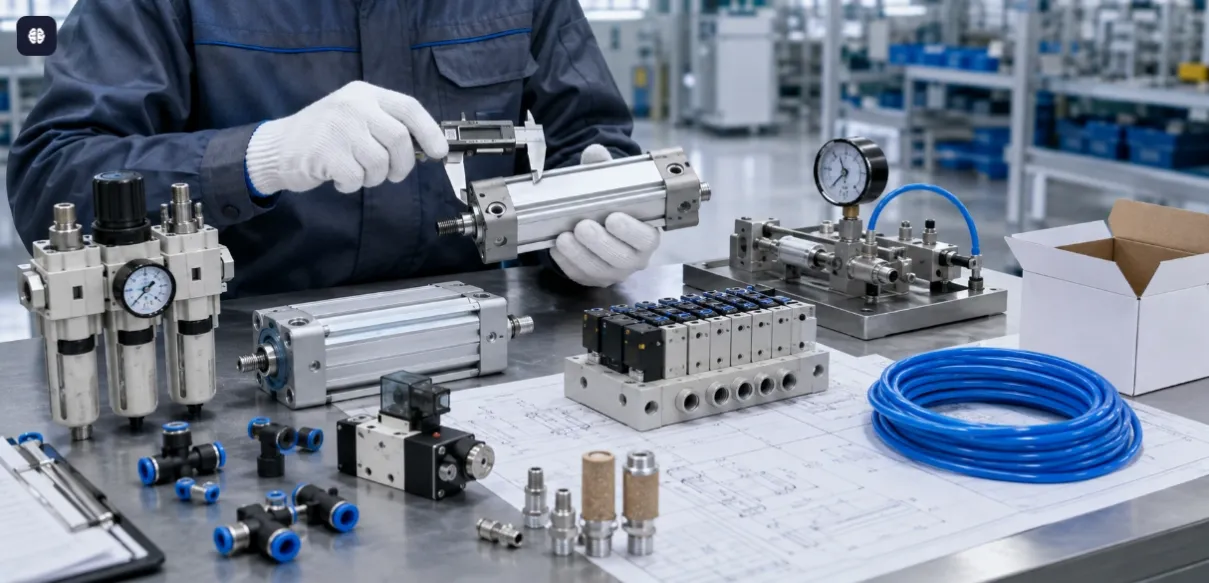
Original equipment manufacturing, commonly known as OEM, allows companies to source pneumatic components that are customized for their machines, applications, or brands. These products may include pneumatic cylinders, solenoid valves, air preparation units, push-in fittings, pneumatic tubing, silencers, manifolds, and other air-control components.
OEM pneumatic components can help distributors expand their product lines and enable machine manufacturers to obtain parts that better match their technical requirements. However, a successful OEM project requires more than comparing prices. Buyers must carefully evaluate product specifications, quality control, customization capabilities, lead times, and supplier reliability.

Define the Technical Requirements Clearly

The first step in any OEM pneumatic project is to prepare a complete technical specification. Providing only a product photo or model number may result in misunderstandings, especially when different manufacturers use similar product codes.
For pneumatic cylinders, buyers should confirm:
  • Cylinder type and mounting method
  • Bore size and stroke
  • Operating pressure
  • Port and thread type
  • Piston rod material
  • Magnet and sensor requirements
  • Cushioning method
  • Seal material
  • Operating temperature
For pneumatic fittings and valves, important information includes tube size, thread standard, working pressure, flow rate, voltage, electrical connection, body material, and sealing material.
Drawings, samples, datasheets, and application details can help the supplier understand the requirements and reduce the risk of incorrect production.

Understand the Available Customization Options

OEM customization can range from simple branding to complete product development. Basic services may include printing a customer’s logo, changing labels, designing packaging, or using customized colors.
More advanced projects may require changes to product dimensions, port locations, mounting holes, materials, seals, voltage, cable length, or internal structure. Some suppliers can also manufacture components according to customer drawings or develop new tooling.
Buyers should confirm which changes are possible and whether they involve additional mold, tooling, testing, or certification costs. They should also ask whether the customized design will remain exclusive or may be offered to other customers.

Evaluate Materials and Product Quality

The quality of a pneumatic component depends heavily on its materials and manufacturing process. Low-cost products may look similar externally but perform very differently in actual operation.
For example, pneumatic fittings should have accurate threads, reliable sealing components, strong release sleeves, and suitable plastic or metal bodies. Cylinders require well-machined barrels, wear-resistant seals, properly treated piston rods, and consistent lubrication. Solenoid valves need stable coils, accurately machined valve bodies, and reliable internal seals.
Buyers should ask suppliers about incoming-material inspection, production testing, leakage testing, dimensional inspection, and final quality control. For critical applications, sample testing should be completed before mass production.

Check Compatibility with Existing Systems

OEM pneumatic parts must be compatible with the buyer’s equipment and regional standards. Thread types are particularly important because PT, NPT, and G threads are not always interchangeable.
Voltage and connector standards must also be verified for solenoid valves. Common coil voltages include 12V DC, 24V DC, 110V AC, and 220V AC. Incorrect specifications can lead to installation problems, air leakage, electrical failure, or unsafe operation.
Buyers replacing an existing brand should compare dimensions, mounting interfaces, flow capacity, pressure range, and function—not only the product appearance.

Confirm MOQ, Pricing, and Lead Time

Minimum order quantity, or MOQ, depends on the level of customization. Logo printing and customized packaging may require relatively small quantities, while new colors, molds, or structural modifications usually require larger orders.
The quotation should clearly state:
  • Unit price and applicable quantity
  • Tooling or mold costs
  • Sample charges
  • Packaging costs
  • Payment terms
  • Production lead time
  • Shipping terms
  • Quotation validity
Buyers should also ask whether the supplier can maintain stable delivery for repeat orders. A low initial price provides little value if quality is inconsistent or replacement products cannot be delivered on time.

Approve Samples Before Mass Production

Pre-production samples are essential for controlling OEM project risk. Buyers should inspect the appearance, dimensions, markings, packaging, and technical performance of each sample.
Whenever possible, samples should be installed and tested in the actual machine. Testing may include leakage, pressure resistance, cycle life, response time, flow performance, temperature resistance, and compatibility with other components.
After approval, both parties should keep a confirmed sample or signed specification as the production standard. Any later changes should be documented in writing.

Select a Reliable OEM Supplier

A capable OEM pneumatic component supplier should provide more than manufacturing. The supplier should communicate clearly, understand technical requirements, recommend suitable solutions, maintain traceable quality records, and respond quickly when problems occur.
Buyers can evaluate a supplier by reviewing its product range, production experience, testing equipment, quality procedures, export experience, sample response, and ability to provide technical documentation.

Conclusion

OEM pneumatic components can help buyers build a distinctive product range, improve machine compatibility, and reduce sourcing costs. However, successful cooperation depends on clear specifications, suitable materials, thorough testing, transparent quotations, and reliable production management.
By approving samples, documenting requirements, and working with an experienced pneumatic supplier, buyers can reduce purchasing risks and establish a stable long-term supply chain for customized pneumatic products.

Read next

Aug 23, 2026pneumatic fittings

OEM Pneumatic Components: What Buyers Need to Know

OEM pneumatic components can help buyers build a distinctive product range, improve machine compatibility, and reduce sourcing costs.

55514478-3754-4001-a445-2c4b03520adf
OEM Pneumatic Components: What Buyers Need to Know
Original equipment manufacturing, commonly known as OEM, allows companies to source pneumatic components that are customized for their machines, applications, or brands. These products may include pneumatic cylinders, solenoid valves, air preparation units, push-in fittings, pneumatic tubing, silencers, manifolds, and other air-control components.
OEM pneumatic components can help distributors expand their product lines and enable machine manufacturers to obtain parts that better match their technical requirements. However, a successful OEM project requires more than comparing prices. Buyers must carefully evaluate product specifications, quality control, customization capabilities, lead times, and supplier reliability.

Define the Technical Requirements Clearly

The first step in any OEM pneumatic project is to prepare a complete technical specification. Providing only a product photo or model number may result in misunderstandings, especially when different manufacturers use similar product codes.
For pneumatic cylinders, buyers should confirm:
  • Cylinder type and mounting method
  • Bore size and stroke
  • Operating pressure
  • Port and thread type
  • Piston rod material
  • Magnet and sensor requirements
  • Cushioning method
  • Seal material
  • Operating temperature
For pneumatic fittings and valves, important information includes tube size, thread standard, working pressure, flow rate, voltage, electrical connection, body material, and sealing material.
Drawings, samples, datasheets, and application details can help the supplier understand the requirements and reduce the risk of incorrect production.

Understand the Available Customization Options

OEM customization can range from simple branding to complete product development. Basic services may include printing a customer’s logo, changing labels, designing packaging, or using customized colors.
More advanced projects may require changes to product dimensions, port locations, mounting holes, materials, seals, voltage, cable length, or internal structure. Some suppliers can also manufacture components according to customer drawings or develop new tooling.
Buyers should confirm which changes are possible and whether they involve additional mold, tooling, testing, or certification costs. They should also ask whether the customized design will remain exclusive or may be offered to other customers.

Evaluate Materials and Product Quality

The quality of a pneumatic component depends heavily on its materials and manufacturing process. Low-cost products may look similar externally but perform very differently in actual operation.
For example, pneumatic fittings should have accurate threads, reliable sealing components, strong release sleeves, and suitable plastic or metal bodies. Cylinders require well-machined barrels, wear-resistant seals, properly treated piston rods, and consistent lubrication. Solenoid valves need stable coils, accurately machined valve bodies, and reliable internal seals.
Buyers should ask suppliers about incoming-material inspection, production testing, leakage testing, dimensional inspection, and final quality control. For critical applications, sample testing should be completed before mass production.

Check Compatibility with Existing Systems

OEM pneumatic parts must be compatible with the buyer’s equipment and regional standards. Thread types are particularly important because PT, NPT, and G threads are not always interchangeable.
Voltage and connector standards must also be verified for solenoid valves. Common coil voltages include 12V DC, 24V DC, 110V AC, and 220V AC. Incorrect specifications can lead to installation problems, air leakage, electrical failure, or unsafe operation.
Buyers replacing an existing brand should compare dimensions, mounting interfaces, flow capacity, pressure range, and function—not only the product appearance.

Confirm MOQ, Pricing, and Lead Time

Minimum order quantity, or MOQ, depends on the level of customization. Logo printing and customized packaging may require relatively small quantities, while new colors, molds, or structural modifications usually require larger orders.
The quotation should clearly state:
  • Unit price and applicable quantity
  • Tooling or mold costs
  • Sample charges
  • Packaging costs
  • Payment terms
  • Production lead time
  • Shipping terms
  • Quotation validity
Buyers should also ask whether the supplier can maintain stable delivery for repeat orders. A low initial price provides little value if quality is inconsistent or replacement products cannot be delivered on time.

Approve Samples Before Mass Production

Pre-production samples are essential for controlling OEM project risk. Buyers should inspect the appearance, dimensions, markings, packaging, and technical performance of each sample.
Whenever possible, samples should be installed and tested in the actual machine. Testing may include leakage, pressure resistance, cycle life, response time, flow performance, temperature resistance, and compatibility with other components.
After approval, both parties should keep a confirmed sample or signed specification as the production standard. Any later changes should be documented in writing.

Select a Reliable OEM Supplier

A capable OEM pneumatic component supplier should provide more than manufacturing. The supplier should communicate clearly, understand technical requirements, recommend suitable solutions, maintain traceable quality records, and respond quickly when problems occur.
Buyers can evaluate a supplier by reviewing its product range, production experience, testing equipment, quality procedures, export experience, sample response, and ability to provide technical documentation.

Conclusion

OEM pneumatic components can help buyers build a distinctive product range, improve machine compatibility, and reduce sourcing costs. However, successful cooperation depends on clear specifications, suitable materials, thorough testing, transparent quotations, and reliable production management.
By approving samples, documenting requirements, and working with an experienced pneumatic supplier, buyers can reduce purchasing risks and establish a stable long-term supply chain for customized pneumatic products.

Aug 23, 2026pneumatic fittings

OEM Pneumatic Components: What Buyers Need to Know

OEM pneumatic components can help buyers build a distinctive product range, improve machine compatibility, and reduce sourcing costs.

55514478-3754-4001-a445-2c4b03520adf
OEM Pneumatic Components: What Buyers Need to Know
Original equipment manufacturing, commonly known as OEM, allows companies to source pneumatic components that are customized for their machines, applications, or brands. These products may include pneumatic cylinders, solenoid valves, air preparation units, push-in fittings, pneumatic tubing, silencers, manifolds, and other air-control components.
OEM pneumatic components can help distributors expand their product lines and enable machine manufacturers to obtain parts that better match their technical requirements. However, a successful OEM project requires more than comparing prices. Buyers must carefully evaluate product specifications, quality control, customization capabilities, lead times, and supplier reliability.

Define the Technical Requirements Clearly

The first step in any OEM pneumatic project is to prepare a complete technical specification. Providing only a product photo or model number may result in misunderstandings, especially when different manufacturers use similar product codes.
For pneumatic cylinders, buyers should confirm:
  • Cylinder type and mounting method
  • Bore size and stroke
  • Operating pressure
  • Port and thread type
  • Piston rod material
  • Magnet and sensor requirements
  • Cushioning method
  • Seal material
  • Operating temperature
For pneumatic fittings and valves, important information includes tube size, thread standard, working pressure, flow rate, voltage, electrical connection, body material, and sealing material.
Drawings, samples, datasheets, and application details can help the supplier understand the requirements and reduce the risk of incorrect production.

Understand the Available Customization Options

OEM customization can range from simple branding to complete product development. Basic services may include printing a customer’s logo, changing labels, designing packaging, or using customized colors.
More advanced projects may require changes to product dimensions, port locations, mounting holes, materials, seals, voltage, cable length, or internal structure. Some suppliers can also manufacture components according to customer drawings or develop new tooling.
Buyers should confirm which changes are possible and whether they involve additional mold, tooling, testing, or certification costs. They should also ask whether the customized design will remain exclusive or may be offered to other customers.

Evaluate Materials and Product Quality

The quality of a pneumatic component depends heavily on its materials and manufacturing process. Low-cost products may look similar externally but perform very differently in actual operation.
For example, pneumatic fittings should have accurate threads, reliable sealing components, strong release sleeves, and suitable plastic or metal bodies. Cylinders require well-machined barrels, wear-resistant seals, properly treated piston rods, and consistent lubrication. Solenoid valves need stable coils, accurately machined valve bodies, and reliable internal seals.
Buyers should ask suppliers about incoming-material inspection, production testing, leakage testing, dimensional inspection, and final quality control. For critical applications, sample testing should be completed before mass production.

Check Compatibility with Existing Systems

OEM pneumatic parts must be compatible with the buyer’s equipment and regional standards. Thread types are particularly important because PT, NPT, and G threads are not always interchangeable.
Voltage and connector standards must also be verified for solenoid valves. Common coil voltages include 12V DC, 24V DC, 110V AC, and 220V AC. Incorrect specifications can lead to installation problems, air leakage, electrical failure, or unsafe operation.
Buyers replacing an existing brand should compare dimensions, mounting interfaces, flow capacity, pressure range, and function—not only the product appearance.

Confirm MOQ, Pricing, and Lead Time

Minimum order quantity, or MOQ, depends on the level of customization. Logo printing and customized packaging may require relatively small quantities, while new colors, molds, or structural modifications usually require larger orders.
The quotation should clearly state:
  • Unit price and applicable quantity
  • Tooling or mold costs
  • Sample charges
  • Packaging costs
  • Payment terms
  • Production lead time
  • Shipping terms
  • Quotation validity
Buyers should also ask whether the supplier can maintain stable delivery for repeat orders. A low initial price provides little value if quality is inconsistent or replacement products cannot be delivered on time.

Approve Samples Before Mass Production

Pre-production samples are essential for controlling OEM project risk. Buyers should inspect the appearance, dimensions, markings, packaging, and technical performance of each sample.
Whenever possible, samples should be installed and tested in the actual machine. Testing may include leakage, pressure resistance, cycle life, response time, flow performance, temperature resistance, and compatibility with other components.
After approval, both parties should keep a confirmed sample or signed specification as the production standard. Any later changes should be documented in writing.

Select a Reliable OEM Supplier

A capable OEM pneumatic component supplier should provide more than manufacturing. The supplier should communicate clearly, understand technical requirements, recommend suitable solutions, maintain traceable quality records, and respond quickly when problems occur.
Buyers can evaluate a supplier by reviewing its product range, production experience, testing equipment, quality procedures, export experience, sample response, and ability to provide technical documentation.

Conclusion

OEM pneumatic components can help buyers build a distinctive product range, improve machine compatibility, and reduce sourcing costs. However, successful cooperation depends on clear specifications, suitable materials, thorough testing, transparent quotations, and reliable production management.
By approving samples, documenting requirements, and working with an experienced pneumatic supplier, buyers can reduce purchasing risks and establish a stable long-term supply chain for customized pneumatic products.


Recommended articles

Guides visitors may want next

Helpful guides, field notes, and stories for choosing with more context.