Aug 19, 2026pneumatic fittings
How Pneumatic Components Improve Material-Handling Equipment
Pneumatic components improve material-handling equipment by providing fast movement, adjustable force, compact installation, and reliable repetitive operation.
How Pneumatic Components Improve Material-Handling Equipment
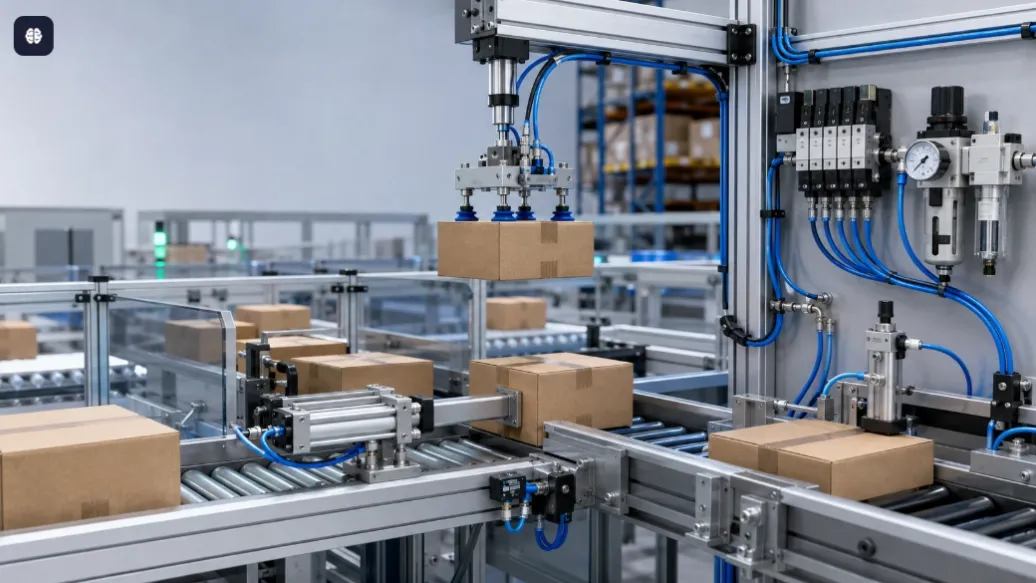
Material-handling equipment plays a critical role in modern manufacturing, warehousing, packaging, and logistics. Products and materials must be lifted, pushed, clamped, transferred, sorted, positioned, and packaged quickly without causing damage or interrupting production.
Pneumatic components are widely used in these systems because they provide fast movement, simple control, compact installation, and reliable repetitive operation. Pneumatic cylinders, solenoid valves, vacuum ejectors, grippers, air preparation units, fittings, and tubing can automate many material-handling functions at a competitive cost.
However, effective pneumatic automation requires more than installing a cylinder and connecting compressed air. Component size, operating pressure, airflow, load direction, cycle frequency, environmental conditions, and energy consumption must all be considered.
This article explains how pneumatic components improve material-handling equipment and how to select a reliable solution for different applications.
What Is Material-Handling Equipment?
Material-handling equipment is used to move, store, control, protect, or position materials during manufacturing, distribution, and storage.
Typical equipment includes:
- Conveyor systems
- Pick-and-place machines
- Robotic end effectors
- Palletizing and depalletizing equipment
- Sorting systems
- Packaging machines
- Loading and unloading stations
- Clamping and positioning fixtures
- Lift tables
- Product pushers
- Transfer mechanisms
- Vacuum lifting systems
- Warehouse automation
- Automated assembly lines
Pneumatic components can perform both the primary movement and the supporting functions within this equipment.
Why Pneumatics Are Suitable for Material Handling
Fast Operating Speed
Pneumatic cylinders can extend and retract rapidly, making them suitable for high-frequency pushing, diverting, sorting, and clamping operations.
Fast valve response and correctly sized airflow paths help machines complete more cycles per minute.
Simple Control
Most pneumatic movements can be controlled using standard directional valves, flow controls, pressure regulators, and sensors. The control signal may come from a PLC, relay, proximity sensor, photoelectric sensor, or manual valve.
This simplicity can reduce machine-building time and make maintenance easier.
Compact Installation
Compact cylinders, valve manifolds, miniature regulators, and small pneumatic fittings can be installed in areas where space is limited.
Rodless cylinders are especially useful for long-stroke applications because their total installation length is shorter than that of an equivalent rod-type cylinder.
Adjustable Force
The output force of a pneumatic cylinder can be adjusted by changing the regulated air pressure. This allows one basic system design to handle products with different weights or levels of fragility.
For delicate products, a precision regulator can reduce the clamping or pushing force and help prevent damage.
Overload Tolerance
A pneumatic cylinder can stall when it meets an obstruction without necessarily causing immediate mechanical damage. This characteristic can be useful in applications where product position or size may vary.
However, overload tolerance does not replace appropriate machine guarding, sensors, or safety controls.
Reliable Repetitive Motion
Quality pneumatic components can perform millions of repetitive cycles when they are correctly sized, aligned, installed, and maintained.
This makes them suitable for continuous production lines and automated warehouses where unplanned downtime is costly.
Main Applications of Pneumatic Components
1. Product Pushing and Diverting
2. Clamping and Holding
3. Pick-and-Place Operations
4. Vacuum Lifting and Transfer
5. Sorting and Rejecting
6. Lifting and Lowering
7. Palletizing and Depalletizing
8. Conveyor Stops and Positioning
9. Packaging and Carton Handling
Essential Pneumatic Components
Pneumatic Cylinders
Solenoid Valves
Valve Manifolds
Air Preparation Units
Pneumatic Fittings
Pneumatic Tubing
Flow Control Valves
Pneumatic Grippers
Sensors and Switches
How Pneumatics Improve Equipment Performance
Higher Productivity
Fast cylinder movement and rapid valve switching can shorten machine-cycle times. Consistent pneumatic operation also reduces delays caused by manual handling.
More Consistent Product Positioning
Guided cylinders, grippers, and regulated air pressure improve positioning repeatability. This is important during assembly, inspection, labeling, and packaging.
Reduced Manual Labor
Pneumatic systems can automate repetitive lifting, pushing, clamping, and sorting tasks. Operators can focus on supervision, quality control, and higher-value work.
Flexible Machine Design
Pneumatic components are available in many sizes and configurations. Machine builders can adapt the system for different products, loads, strokes, and operating sequences.
Easier Maintenance
Standard cylinders, valves, fittings, and tubing can often be replaced without specialized equipment. Modular air preparation and valve manifolds can further simplify maintenance.
Lower Initial Cost
For simple two-position movements, pneumatic systems often have a lower initial cost than complex electric-motion systems.
The best choice should still be based on total operating cost, accuracy, energy consumption, and application requirements.
Improving Energy Efficiency
Compressed air is convenient but expensive to generate. Poorly designed pneumatic systems may waste energy through leakage, excessive pressure, oversized cylinders, and continuous vacuum generation.
Use the Lowest Practical Pressure
Operating an entire machine at unnecessarily high pressure increases air consumption and leakage.
Use pressure zoning when different functions require different forces. For example, a heavy lifting function may require higher pressure than a carton-positioning cylinder.
Select the Correct Cylinder Size
An oversized cylinder consumes unnecessary compressed air during every cycle. High-frequency equipment can generate substantial savings when cylinder bore sizes are optimized.
Reduce Tubing Volume
Install valves close to actuators and avoid unnecessary tubing length. Shorter tubes can improve response time and reduce the volume of compressed air exhausted during each cycle.
Control Vacuum Consumption
Vacuum ejectors should not operate continuously if the required vacuum level has already been reached.
Vacuum switches and air-saving control circuits can stop airflow until the vacuum level falls below a defined limit.
Shut Off Idle Equipment
Automatic shutoff valves can isolate machines or production zones during breaks, maintenance periods, and non-production hours.
A controlled soft-start function can repressurize the system gradually when production resumes.
Common Problems and Solutions
Slow Cylinder Movement
Irregular or Jerky Motion
Product Damage
Vacuum Product Drops
Frequent Fitting Leakage
Preventive Maintenance Recommendations
Daily or Shift Checks
Weekly Checks
Scheduled Maintenance
Conclusion
Pneumatic components improve material-handling equipment by providing fast movement, adjustable force, compact installation, and reliable repetitive operation.
Pneumatic cylinders perform pushing, lifting, clamping, and positioning. Solenoid valves control actuator movement. Vacuum components handle cartons, sheets, bags, and panels. Air preparation units protect the system, while reliable fittings and tubing maintain efficient airflow.
The greatest benefits are achieved when the complete pneumatic circuit is correctly designed. Proper cylinder sizing, adequate valve flow, short tubing, clean compressed air, pressure optimization, and preventive maintenance can improve productivity while reducing leakage, energy consumption, and unplanned downtime.
For machine builders and equipment operators, selecting pneumatic components based only on purchase price can create higher long-term costs. Reliable materials, consistent manufacturing, technical compatibility, and dependable supply are essential for successful material-handling automation.