Aug 16, 2026pneumatic fittings
Metric vs Inch Pneumatic Fittings: A Practical Selection Guide
Metric vs Inch does not always refer to the thread,and how to identify
Metric vs Inch Pneumatic Fittings: A Practical Selection Guide
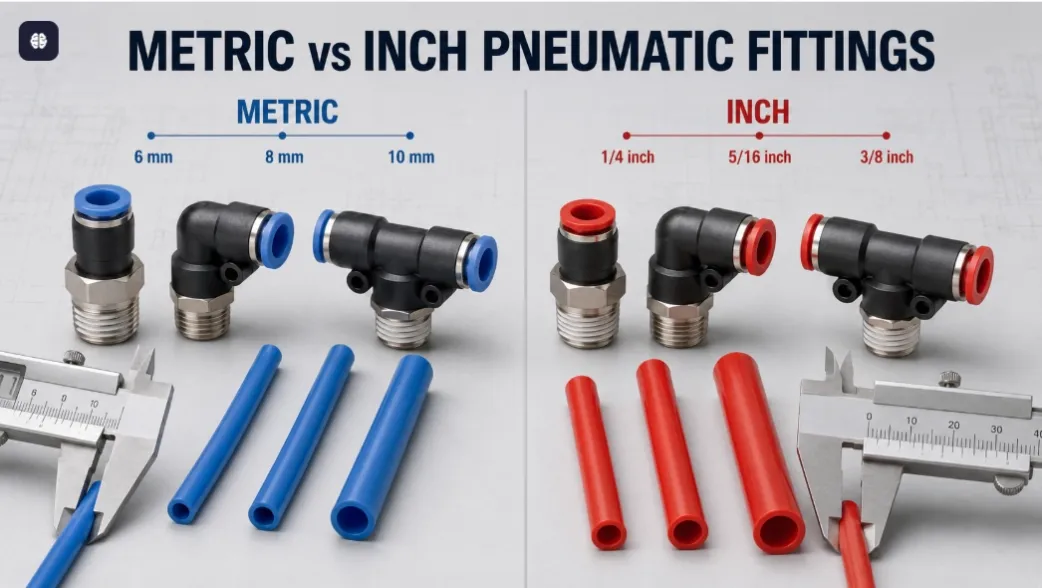
Pneumatic fittings are available in both metric and inch sizes. Although the difference may appear small, choosing the wrong fitting can cause difficult tube installation, weak tube retention, air leakage, pressure loss, or damage to the fitting.
For machine builders, maintenance engineers, pneumatic distributors, and international buyers, it is therefore important to understand how metric and inch pneumatic fittings are measured and how to select the correct option.
This guide explains the differences between metric and inch pneumatic fittings, common tube and thread sizes, identification methods, and the key information you should confirm before ordering.
What Is a Metric Pneumatic Fitting?
A metric pneumatic fitting is designed for tubing with an outside diameter measured in millimeters.
Common metric pneumatic tube sizes include:
- 4 mm
- 6 mm
- 8 mm
- 10 mm
- 12 mm
- 14 mm
- 16 mm
For example, a metric push-in fitting marked “8” is normally designed for pneumatic tubing with an outside diameter of 8 mm.
Metric fittings are widely used in Europe, Asia, and many international industrial automation systems. They are commonly installed in packaging machinery, textile equipment, automated assembly lines, robotics, printing machinery, and general pneumatic control systems.
What Is an Inch Pneumatic Fitting?
An inch pneumatic fitting is designed for tubing with an outside diameter measured in inches or fractions of an inch.
Common inch tube sizes include:
- 1/8 inch
- 5/32 inch
- 1/4 inch
- 5/16 inch
- 3/8 inch
- 1/2 inch
Inch pneumatic fittings are commonly used in the United States, Canada, and machinery manufactured according to North American standards.
For example, a 1/4-inch push-in fitting is designed for tubing with an actual outside diameter of 1/4 inch, which equals 6.35 mm.
Metric and Inch Tube Size Comparison
Some metric and inch sizes appear similar, but they are not exactly the same.
Metric tube size | Similar inch size | Actual inch diameter | Difference |
4 mm | 5/32 inch | 3.97 mm | 0.03 mm |
6 mm | 1/4 inch | 6.35 mm | 0.35 mm |
8 mm | 5/16 inch | 7.94 mm | 0.06 mm |
10 mm | 3/8 inch | 9.53 mm | 0.47 mm |
12 mm | 1/2 inch | 12.70 mm | 0.70 mm |
This table is useful for comparison, but similar dimensions should not automatically be treated as interchangeable.
For example, inserting a 6 mm tube into a fitting designed for 1/4-inch tubing may produce insufficient sealing or tube retention because the 1/4-inch tube diameter is actually 6.35 mm. Likewise, a 1/4-inch tube may be too large for a 6 mm fitting and could damage the internal sealing ring or gripping mechanism.
Always match the fitting to the exact outside diameter of the tube.
Tube Size and Thread Size Are Different
One of the most common purchasing mistakes is confusing the tube size with the thread size.
A push-in pneumatic fitting normally has two important dimensions:
- Tube outside diameter
- Connection thread size and standard
For example, a fitting specification may be written as:
PC8-02
Depending on the manufacturer’s model system, “8” may indicate an 8 mm tube size, while “02” may indicate a 1/4-inch threaded connection.
This means a metric tube connection can be combined with an inch-based pipe thread. Therefore, a fitting described as “metric” does not necessarily have a metric thread.
Before ordering, both dimensions must be confirmed separately.
Common Pneumatic Fitting Thread Standards
Pneumatic fittings are available with several thread types. The most common are PT, R, G, NPT, and metric threads.
PT or BSPT Thread
PT is a tapered pipe thread commonly used in pneumatic systems in Asia. It is closely associated with the BSPT thread system and is often used with thread sealant or PTFE tape.
Common sizes include:
- PT 1/8
- PT 1/4
- PT 3/8
- PT 1/2
R Thread
R is an external tapered pipe thread defined under the ISO 7-1 system. In many pneumatic applications, it is used for connections commonly described commercially as BSPT-type connections.
However, buyers should still confirm the exact thread specification required by their equipment.
G or BSPP Thread
G is a parallel pipe thread. Unlike tapered threads, G threads typically require a sealing washer, O-ring, or sealing surface to create an airtight connection.
Common sizes include:
- G 1/8
- G 1/4
- G 3/8
- G 1/2
NPT Thread
NPT is a tapered thread standard commonly used in the United States and Canada.
Common sizes include:
- NPT 1/8
- NPT 1/4
- NPT 3/8
- NPT 1/2
Although NPT and BSPT threads may look similar, their thread angle, pitch, and profile are different. They should not be considered directly interchangeable.
Metric Thread
Some pneumatic components use metric threads such as:
- M5
- M6
- M8
- M10
- M12
Metric threads are identified by their nominal diameter and thread pitch. For example, M5 × 0.8 indicates a nominal thread diameter of 5 mm and a pitch of 0.8 mm.
Metric vs Inch Does Not Always Refer to the Thread
When buyers ask for a metric or inch pneumatic fitting, they may be referring to one of three things:
- The pneumatic tube outside diameter
- The fitting’s threaded connection
- Both the tube size and the thread specification
For this reason, a request such as “I need an 8 mm fitting” is incomplete. The supplier also needs to know the required thread type and size.
A complete specification should look like this:
8 mm tube × G 1/4 male thread
or:
1/4-inch tube × 1/8 NPT male thread
Providing the full specification helps prevent ordering mistakes.
How to Identify a Metric or Inch Pneumatic Fitting
If the original packaging or model number is unavailable, the fitting can be identified through several methods.
1. Check the Product Marking
Look for numbers or symbols printed or engraved on the fitting. A marking such as 6, 8, 10, or 12 may indicate a metric tube size. A fractional marking such as 1/4 or 3/8 usually indicates an inch tube size.
However, product markings vary between manufacturers, so they should be confirmed against a catalog whenever possible.
2. Measure the Tube Outside Diameter
Use a vernier caliper to measure the outside diameter of the pneumatic tube.
Typical results include:
- Approximately 6.00 mm: 6 mm metric tubing
- Approximately 6.35 mm: 1/4-inch tubing
- Approximately 8.00 mm: 8 mm metric tubing
- Approximately 9.53 mm: 3/8-inch tubing
- Approximately 12.70 mm: 1/2-inch tubing
For accurate identification, avoid measuring with a ruler, especially when the dimensional difference is less than one millimeter.
3. Measure the Thread Diameter
A caliper can help determine the approximate outside diameter of a male thread. However, thread diameter alone is not enough to identify the standard.
The thread pitch, taper, and profile must also be checked. A thread gauge is recommended when distinguishing between PT, G, NPT, and metric threads.
4. Check the Machine’s Country of Origin
The country where the machine was designed or manufactured can provide a useful clue:
- European and Asian equipment often uses metric tubing
- North American equipment often uses inch tubing and NPT threads
- Japanese and other Asian machinery may use metric tubing with PT or R threads
- European equipment may use metric tubing with G or R threads
This is only a general reference. The actual dimensions should always be measured and confirmed.
Can Metric Tubing Be Used with Inch Fittings?
Metric tubing should normally be used with metric fittings, while inch tubing should be used with inch fittings.
Even when two sizes are close, a dimensional mismatch may cause:
- Air leakage
- Weak tube retention
- Difficult tube insertion
- Damage to the internal O-ring
- Premature fitting failure
- Unexpected tube release under pressure
A temporary connection may appear to work during installation but fail after vibration, pressure cycling, or long-term operation.
Reducers or conversion fittings should be used when a system must connect metric tubing to inch tubing.
How to Select the Correct Pneumatic Fitting
Follow these steps before placing an order.
Step 1: Confirm the Tube Outside Diameter
Measure the pneumatic tube and determine whether it is metric or inch-sized.
Do not identify the size only by visual appearance.
Step 2: Identify the Thread Standard
Confirm whether the equipment requires PT, R, G, NPT, or metric threads.
Do not force a fitting into a port with a different thread standard.
Step 3: Confirm the Thread Size
Common thread sizes include 1/8, 1/4, 3/8, and 1/2 inch, as well as M5 and other metric sizes.
Step 4: Choose the Correct Fitting Type
Select the fitting configuration according to the piping layout:
- Straight fitting
- Elbow fitting
- Tee fitting
- Y fitting
- Bulkhead fitting
- Reducer fitting
- Flow-control fitting
- Banjo fitting
- Plug
Step 5: Check the Working Conditions
Confirm the following operating requirements:
- Working pressure
- Operating temperature
- Tube material
- Compressed-air quality
- Required flow rate
- Installation environment
- Vibration level
- Fluid compatibility
Step 6: Verify Material and Construction Quality
The dimensions may be correct, but poor construction can still cause leakage or premature failure.
Important quality details include:
- Durable release caps made from consistent material
- Accurate tube and thread dimensions
- Wear-resistant sealing rings
- Strong tube-gripping components
- Sufficient threaded-section thickness
- Brass internal components where required
- Smooth molding and machining
- Reliable factory inspection
Our pneumatic fittings use virgin material for the caps, a reinforced threaded connection, and brass plug components. These details help improve structural strength, tube connection stability, and long-term durability.
Common Selection Mistakes
Assuming 6 mm and 1/4 Inch Are the Same
A 6 mm tube and a 1/4-inch tube differ by 0.35 mm. This is enough to affect sealing and tube retention.
Selecting Only by Thread Diameter
Different thread standards can have similar outside diameters. Thread pitch, angle, and taper must also be considered.
Mixing NPT and BSP Threads
NPT, BSPT, and BSPP fittings are manufactured according to different thread profiles. Forcing incompatible threads together may damage the equipment port and create leakage.
Confusing Tube Inside Diameter with Outside Diameter
Push-in fittings are normally selected according to the tube’s outside diameter, not its inside diameter.
Reusing a Damaged Tube End
Even with the correct fitting size, a scratched, oval, or unevenly cut tube may not seal correctly. Cut the tube squarely with a suitable tube cutter before installation.
Selection Examples
Example 1: European Packaging Machine
The machine uses 8 mm polyurethane tubing and a G 1/4 port.
Recommended specification:
8 mm tube × G 1/4 male pneumatic fitting
Example 2: American Automation Equipment
The equipment uses 1/4-inch tubing and a 1/8 NPT connection.
Recommended specification:
1/4-inch tube × 1/8 NPT male pneumatic fitting
Example 3: Connecting Metric and Inch Tubing
A machine upgrade requires an 8 mm tube to connect with a 1/4-inch pneumatic line.
Recommended solution:
8 mm × 1/4-inch tube reducer fitting
A purpose-designed reducer is more reliable than inserting one tube size into a fitting designed for another.
Conclusion
Choosing between metric and inch pneumatic fittings requires more than comparing approximate dimensions. Buyers must confirm the exact tube outside diameter, thread standard, thread size, fitting configuration, and operating conditions.
The most important rule is simple: never assume that similar-looking tube or thread sizes are interchangeable.
Accurate sizing helps prevent air leakage, tube release, damaged threads, and unnecessary maintenance. If you are uncertain about a fitting specification, measure the existing tube and port carefully or provide the supplier with a sample, drawing, or clear photographs.
We offer pneumatic fittings for both metric and inch tubing, with multiple thread options including PT, NPT, and G. Contact us with your tube size, thread requirement, and application details, and our team will help you select the appropriate fitting for your pneumatic system.